

Most teachers remember poetry lessons from their own school years the same way: long poems, complicated symbolism, and endless analysis that made everyone (including the teacher) want to fall asleep.
That doesn’t have to be the way you teach poetry in the classroom.
One of my favorite weekly routines was Poetry Friday: a simple, discussion-based approach that repeated every week through the year.
Poetry Friday helped students enjoy poetry while naturally building reading comprehension, vocabulary, speaking skills, and confidence over time.
(Related Reading: 5 Benefits to Teaching Poetry in the Classroom)
What Is Poetry Friday?
Poetry Friday is the name I gave to a weekly routine where students and I read and discussed a new poem every week – usually on Friday.
(Sometimes we had Poetry Tuesday because of schedule hijinks, but the students were familiar enough with the routine that they just rolled with it.)
Each Poetry Friday experience started with reading a new poem and a surface-level discussion of it. I would teach one element of poetry or writing, such as metaphor, repetition, or rhythm. Then students would write their own poems based on the one we’d read and discussed.
It was simple, it was engaging, and it required very little prep once students knew the routine.
Whether you teach upper elementary or middle school, here’s how to teach Poetry Friday (or Thursday, or Tuesday) every week.
Step One: Choose a Poem
It’s hard to teach poetry without poems, so before you start teaching poetry in the classroom, it’s important to have a few poems on hand.
When looking for poems, make sure that they’re both age- and culture-appropriate. (That means that if you find a poem in Spanish, make sure you actually know what the words mean and that they’re being used respectfully, especially if you have native Spanish speakers in your class.)
Choose one poem to start, and make enough copies for every student to have one.
(Students won’t be annotating, unless you want them to, but having students hold the poem in their hands will help them focus on the words, especially as you get into the teaching portion of Poetry Friday.)
Step Two: Prepare Students for Discussion
I like to have students put their desks in a circle to prepare for Poetry Friday.
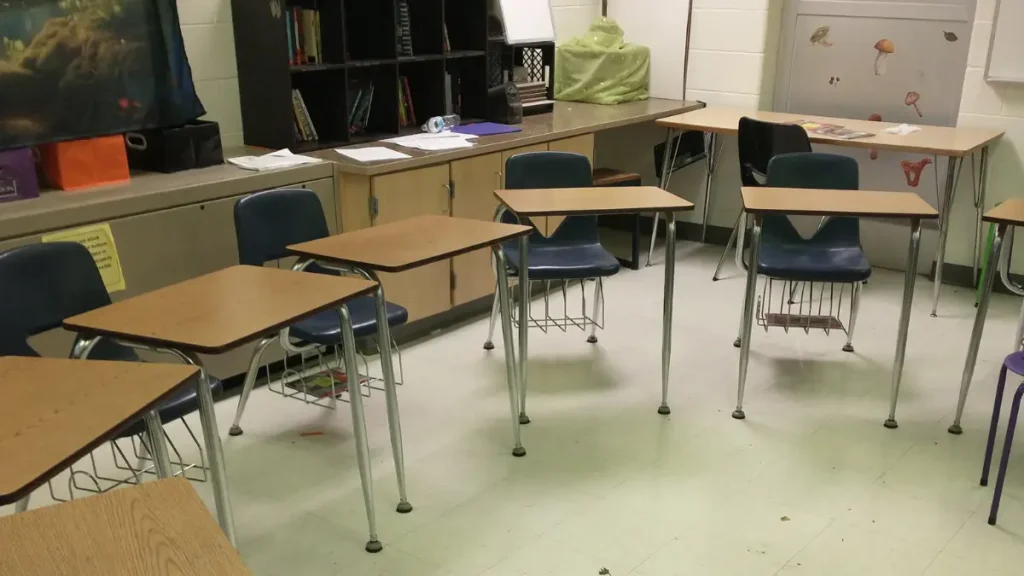
When the desks are in groups or rows, it’s too easy to have the teacher be the center of the discussion:
- Teacher asks a question
- Students respond
- Teacher elaborates on their response
- Teacher asks another question
- Students respond
- And so on
For older students especially (my sixth graders were able to handle this), try having them respond to each other’s discussion points. I’ll say more about this in step six.
After the desks are in a circle or the room is set up in a way that facilitates discussion, distribute the poems.
Pro Tip: Students don’t need pencils for this part, and having them clear their desks will cut down on a lot of distracted doodling.
Step Three: Read the Poem Aloud
Poetry is meant to be read out loud. It naturally brings out your Poetry Voice – a way of speaking that does not sound natural…unless you’re reading poetry.
And because you’re a prepared and fluent reader, you’re able to model Poetry Voice for students. This includes things like pausing at the end of lines (“enjambment” is the official word for this; it’s like half of a comma in terms of pause length) and emphasizing certain words.
If you’re not accustomed to reading poetry out loud, practice each poem before students come into your room for the day.
Reading poetry out loud gets easier with practice, especially if you keep the same poems from year to year.
Step Four: Discuss the Poem
After you read the poem once, ask students, “What did you notice?”
And then wait.
The first few times you do this, the silence will probably stretch to uncomfortable limits, and that’s ok.
After students start shifting awkwardly or staring at their desk and refusing to make eye contact, you can gently prompt them:
- Do any of the words rhyme?
- Did the poet use any figurative language?
- What is this poem about?
- Are the lines long or short?
(Related Reading: 5 Common Poetry Teaching Mistakes (and How to Avoid Them))
Eventually, students will start to notice these things on their own, and your classroom discussions will grow more complex as you do more Poetry Friday experiences.
(Related Reading: 20 Poetry Discussion Questions That Get Students Talking)
Pro Tip: If students have ideas but are hesitant to share them, direct them to turn and talk to a neighbor. You walk around the inside of the circle and eavesdrop, then share what you heard without making the students speak in front of the class themselves.
Step Five: Select Volunteers to Read With You
Ask for several volunteers to read parts of the poem with you.
You might ask students to:
- Read a bolded word
- Read the first line of each stanza
- Read every line that starts with a particular word
Shy or uncomfortable students can choose a partner to read with them.
You read the rest of the poem.
Step Six: Discuss the Content
Content (the topic the poem focuses on) is much more accessible to students than craft (how the poem is constructed).
You might ask students to share their personal experiences connected with the poem’s topic. For example, if the poem is about a cat that ran away, you might ask if any of them have experiences with missing pets.
You can also ask students to conduct a short research experience (which is part of many states’ ELA standards) about the content of the poem. If the poem is about an animal, ask students to do some research about that animal and share the most interesting thing they learned.
Suggestions for research and discussion topics are included in the Classful of Poets teacher’s guide.
Step Seven: Teach One Poetry Craft Element
Pick just one craft element of the poem to discuss.
Your state and grade-level standards are a great starting point if you’re building this for yourself. (Craft elements are already selected and scripted out in A Classful of Poets.)
When selecting a craft element to focus on, remember that it’s ok to repeat element focuses later in the year. In fact, doing so will help students start to notice the craft element automatically and across multiple texts and genres.
For example, if you start the year talking about similes, consider pulling in a poem in December that also uses similes. Then pull another one in March, but focus on a different craft element.
See who points out the simile during the “What did you notice” phase.
Pro Tip: This is the time for you to teach. It’s not a long time, so make sure your craft element is narrow, focused, and singular. As much as you might want to dig into symbolism and rhythm and metaphor all at once, remember that for most of your students, this is all new. Pick one thing to focus on at a time. The rest will come later, I promise.
Step Eight: Read the Poem Again
Remind students about the discussions they had. Tell them, “We talked about how to find a missing pet, and we noticed the three similes in this poem.” Be explicit in telling them exactly what you talked about.
Then tell them, “Think about those things, and listen for the similes as I read the poem again.”
By giving them something to focus on while you read this (now familiar) text, you’re helping their brains connect new learning in a way that will make it easier to recall later.
Step Nine: Let Students Write Their Own Poems
Have students turn their papers over (assuming the back is blank) or get a piece of paper to write on.
Give them a direction to write a poem either about the same topic or using the same craft element you just taught them about.
Some poems lend themselves more to one or the other, so this is something that will come easier with time.
At first, expect students to copy the line structure or wording. They might also write from edge to edge of the paper, as if they were writing prose.
This is ok!
Don’t overcorrect here, because the goal is for them to simply try something new, something that might be a little uncomfortable, and to realize that it’s safe to take academic risks in your class.
Pro Tip: If you have students whose first language isn’t English, encourage them to write in their home language. They might write the entire poem in their language, or they might work single words or phrases into a poem that’s mostly in English. This tells them that you acknowledge their culture and language and gives them an easier access point than writing an entire poem in (what is to them) a foreign language.
Step Ten: Resist Grading Every Poem
It might be tempting to collect the poems for a grade at this point.
Resist that urge.
Sure, most of the poems will end up in the recycling bin or garbage can on the way out of class. But the point is not the end product; the point is the process.
I had a class of reluctant eighth graders who hated poetry. They hated talking about it, they hated reading it, and they hated writing it. With a passion.
But by not collecting the poems, and by encouraging (making) them write at least two lines every week, by the end of the year I had several students writing full-on poems and proudly sharing their words with their friends.
The only time I collected the poems was when a sub had to step in mid-period and I wanted to make sure students actually did the work. And even then, I didn’t read the poems themselves; I simply checked for names and that something was written.
That trust was what led one of my classes to share their innermost thoughts, fears, and worries during the poetry discussion step. They knew I wouldn’t force them to take any uncomfortable actions, and that their words were safe in my class.
Plan Your Poetry Friday Experience
Whether you pick Friday or some other day of the week, keep the day and routine as consistent as possible.
I created A Classful of Poets to help other teachers follow this same routine with ready-to-use poems and discussion prompts, because I want you to have that same level of trust and respect with your students too.

Before you comment: Please take a moment to read our community guidelines. We’re building a space that’s welcoming, respectful, and helpful to all!
F.A.Q.
Poetry Friday is a weekly classroom routine where students read, discuss, and respond to a poem together. Rather than analyzing every literary device at once, students gradually build poetry skills through repeated exposure and discussion.
Most Poetry Friday lessons take about 20–30 minutes. The discussion can be shortened or expanded depending on your students’ age and how much time you have available.
Absolutely. Middle school students often respond well to modern, relatable poems that connect to their own experiences. Short discussions and low-pressure writing activities help reluctant readers participate without feeling overwhelmed.
No. Simply holding a printed copy of the poem is often enough. Annotation can be added later, but it isn’t necessary for students to engage meaningfully with the text.
Not usually. Allowing students to write without worrying about a grade encourages creativity, risk-taking, and authentic expression. The focus should be on practicing the writing process rather than producing a perfect final product.
A consistent weekly routine works well because students begin recognizing poetic techniques naturally over time. Even one poem each week can significantly improve students’ confidence and appreciation for poetry.