Some of the best poetry discussions I’ve ever had with students started with a surprisingly simple question.
After many years of running weekly Poetry Friday experiences with my students, I learned that the questions that seemed almost too simple were often the ones that got students talking the most.
For example, one Friday I asked my students, “What’s something we do in school that doesn’t seem to make sense?”
That question turned into a multi-hour rant and discussion…one that students were still continuing after class ended!
Here’s what I figured out: You don’t need a complicated question to have a meaningful conversation about a poem. You just need the right question, and enough space for students to think about it.
These poetry discussion questions are the ones I found myself returning to again and again. Some ask students to look closely at the words and craft of a poem. Others help them connect a poem to their own experiences, other texts, or the world around them.
(By the way, you don’t need to use all 20 questions with every poem. Pick one or two that fit the poem and your students, then see where the conversation takes you.)
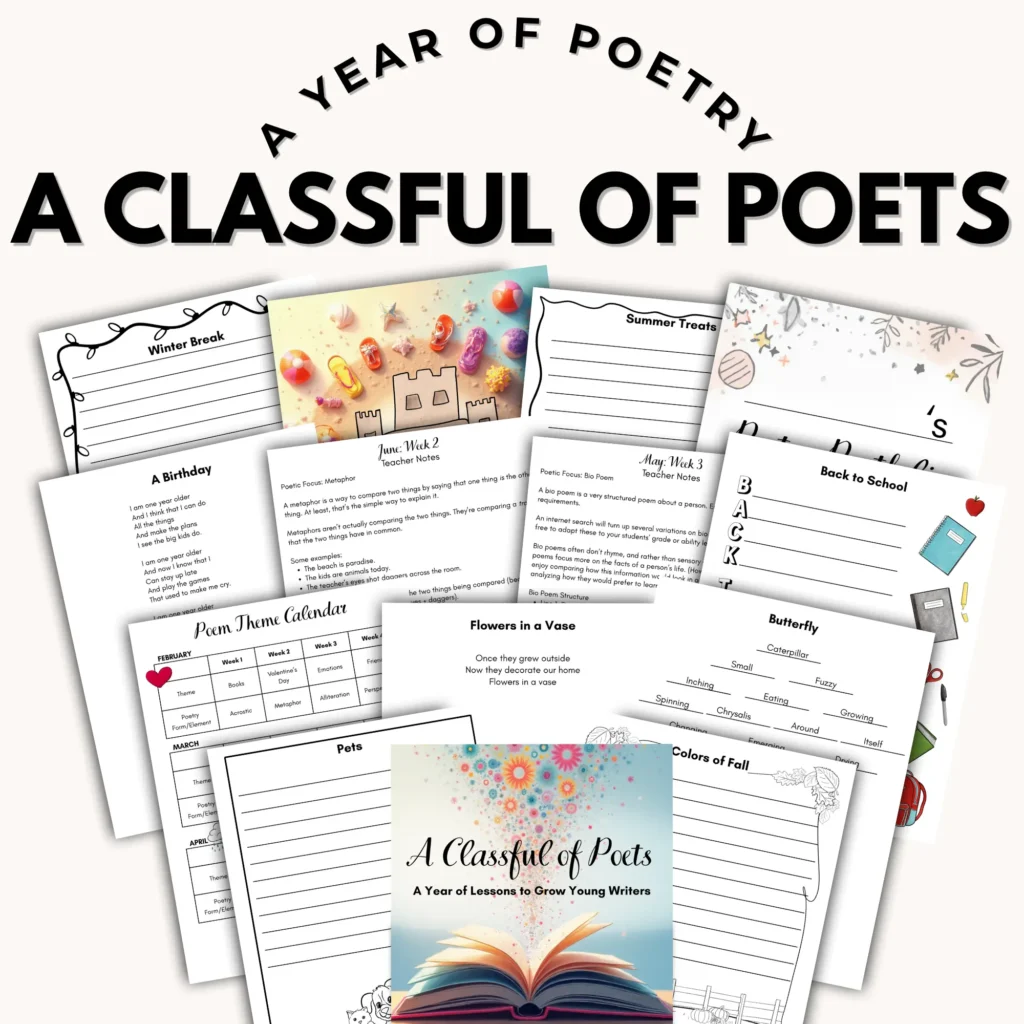
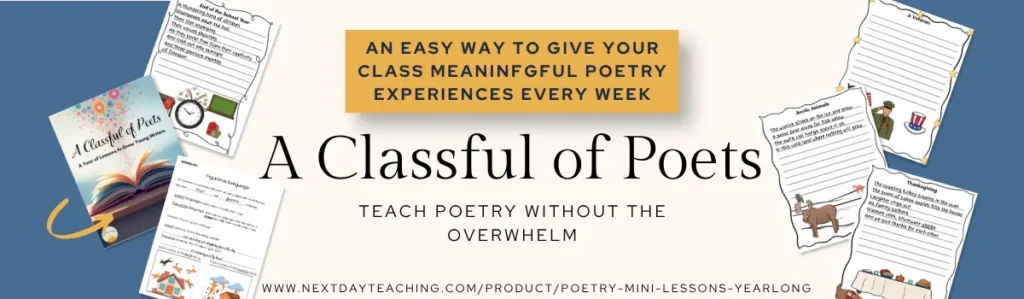
I created A Classful of Poets to spark discussions like this. Each poem comes with a teacher guide that includes multiple discussion questions to get your students thinking and talking.
But you don’t need poem-specific questions to get started. These poetry discussion questions are intentionally broad, so you can use them with almost any poem.
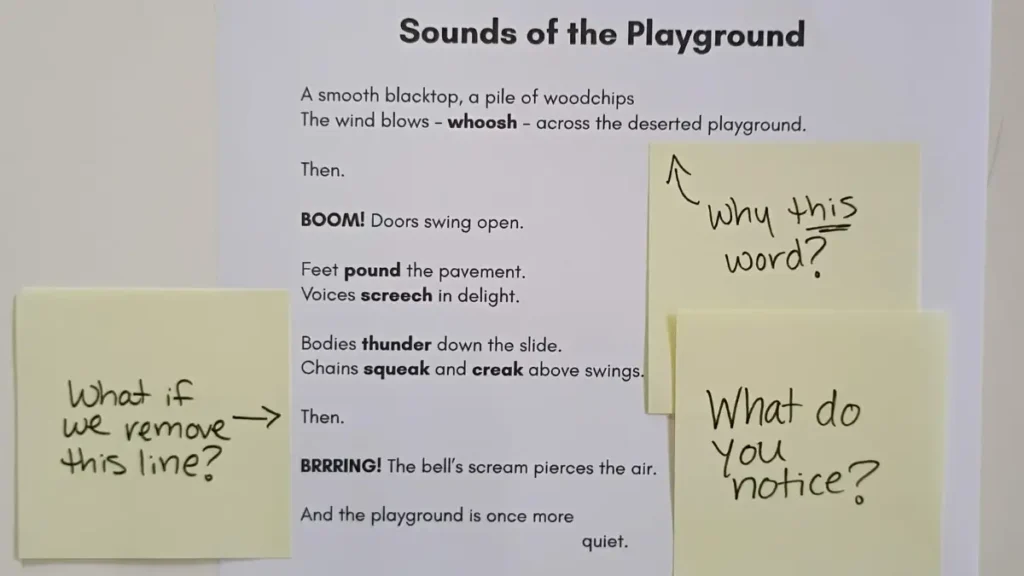
- What did you notice?
- What’s happening in the poem?
- Have you ever _?
- What does [this word] mean?
- Why did the author choose [this word]?
- What else have you read, watched, or seen that reminds you of [this poem]?
- How would this poem be different as a story? As a paragraph? As a movie script?
- What facts do you know about [the poem’s topic]?
- How is [this line/word] surprising?
- What words stand out to you? Why?
- How would this poem be different if we removed this [stanza/line/word]?
- What sort of song would this poem be?
- How are the long lines read differently than the short lines?
- What emotions do you feel reading this [poem/stanza/line/word]?
- What figurative language do you notice in this poem?
- Why did the author choose to use [this type of figurative language] in [this line]?
- How would the poem change if the author… [made it longer, made it shorter, used onomatopoeia, etc.]?
- When would be the best time to read this poem?
- What bigger story could this poem be a scene from?
- What do you like or dislike about this poem?
- How to Use These Poetry Discussion Questions
- F.A.Q.
What did you notice?
This is my favorite question to start with after reading a poem because it’s so open-ended. It gives space to the student who notices “the poem rhymes” as much as to the student who notices figurative language or line length.
Pro Tip: After you ask this question, pause and let the silence settle for a bit. Don’t jump in right away.
Pro Tip #2: Expect this question to be met with silence for the first few weeks. The more you talk about poems, and the more low-stakes you make this question, the better answers you’ll get later in the year.
What’s happening in the poem?
With young readers or English language learners, it’s important to address the content of the poem as much as the craft. Poets often use advanced vocabulary and atypical sentence structure, even when writing about something mundane.
Pro Tip: Let older students turn and talk to share their ideas with someone sitting near them before asking them to share with the whole class.
Have you ever _?
It’s important to show students that even if they haven’t experienced the events of a poem, they can still connect with the emotions wrapped inside it. For example, maybe they haven’t baked cookies with their Grandma, but they’ve gone to a soccer game with their cousin. The emotion is the same (family togetherness), even though the event and situation details are different.
What does [this word] mean?
Sometimes poets use words in uncommon ways. Sometimes poets make up words entirely! And sometimes poets choose words that are advanced. Either way, asking students to identify what a particular word means sets them up for future higher-level questions to come. (See next question.)
Why did the author choose [this word]?
Asking students to define or explain a word is one thing. Asking them to analyze why the author chose that word in particular? Now they have to think deeper. Students might talk about the sound of a word, or the number of syllables it has. They might point out a double meaning, or a rhyme. No matter how students answer (unless it’s way off base), be sure to praise their efforts. This is a tough question!
Pro Tip: If students get stuck on this question, ask them what other words the author might have used instead. Sometimes seeing the other options that the author could have used…but didn’t…will help them analyze the actual word that was used.
What else have you read, watched, or seen that reminds you of [this poem]?
It’s just as important to show students how to zoom out away from a poem (what this question does) as it is to zoom in to specific parts of a poem (what most questions do). Plus, this is a great question to get to know your students’ interests.
How would this poem be different as a story? As a paragraph? As a movie script?
Students might not realize that authors can choose the format they use to deliver their words, and they each have their strengths and downfalls. Prose novels or short stories can give more information than poems. Paragraphs often prevent authors from emphasizing words as much as poems do. And movies are entirely visual; the actual script is often very sparse. This question (or series of questions) gets students thinking about how each of these mediums are different, and how each serves a different purpose
What facts do you know about [the poem’s topic]?
Some poems (especially bio poems) are filled with facts. This is a great opportunity to let your more fact-oriented students (who often resist poetry and fiction genres) share their knowledge.
Pro Tip: Follow up this question with a short research opportunity. Give students five minutes on their devices, or pull up a website at the front of the room. Prepare students to share their favorite fact when time is up.
How is [this line/word] surprising?
I like this question better than asking, “What surprised you in this poem?” because by just asking students about what surprised them, about half the class will answer, “Nothin’.” By telling them upfront this line is surprising!, you help them know what to look for and what type of answer you’re looking for. And really, asking how something is surprising is much higher-level than asking what is surprising.
What words stand out to you? Why?
This is another question (or pair of questions) that allow a multitude of answers, and I often find the reasoning more insightful than simply identifying the standout words. Some students might comment on a repeated word. (Yes! Praise that!) Others might point out words with a figurative meaning (praise that!) or words in bold or italics (praise, praise, praise).
Side Note:
If it seems like I’m advocating for a lot of student praise, that’s because I am. Many students go through school not enjoying poetry, and not enjoying class discussions. By the time they get old enough to handle mature, in-depth conversations about truly analyzing poetry and author craft, they’ve been turned off and they check out.
You can disrupt that by praising even the “simple” or “basic” answers they give. You can even praise wrong answers!
Once students see that participating in discussions in your class brings praise, they’ll be more likely to keep participating…and eventually share those deep, inner thoughts you’re going after.
How would this poem be different if we removed this [stanza/line/word]?
Poetry is so precise – because it’s so short. Every word, every line break, every spacing decision is deliberately chosen. This question asks students to consider what they would miss out on if a piece of the poem – something so essential that it made the final cut – was taken out.
What sort of song would this poem be?
Poetry is more closely related to songs than it is to prose (paragraph writing), yet the majority of students prefer songs to poems. It’s interesting to ask students to think about what type of song a poem would produce because this gets them to make the connection between poems and songs on their own.
Pro Tip: If you have any musically-inclined students in your class, they might enjoy crafting a melody to go along with the poem. But don’t force anyone to perform unless they want to!
How are the long lines read differently than the short lines?
Poets choose line breaks carefully, because line breaks change the way we read a poem. Most poems use something called enjambment, which happens when the sentence or phrase continues across the line break, even if there’s no punctuation mark there. This enjambment can slow the reader down, emphasize a word or idea, or even change the way a phrase sounds. Ask students to read a long line…and then a short one. Have them think about how the line break affects the way they read each line.
What emotions do you feel reading this [poem/stanza/line/word]?
Not all poems are rooted in emotion, but many are. With higher-level students, this is also a good opportunity to talk about connotation – the culturally-accepted feeling behind some words that make them seem generally good or generally bad.
What figurative language do you notice in this poem?
Many times students are used to either breezing through a poem (because it’s short) or being forced to return to the same text over and over to analyze it for a teacher or test. Hopefully by keeping this question open-ended, they’ll start to notice figurative language on their own (without you prompting them to constantly go back to the text).
Pro Tip: Make sure to only ask this question for poems that have figurative language in them!
Pro Tip #2: If students are struggling, guide them by pointing out a stanza or line that has figurative language and asking them about that stanza or line specifically. For example, “What figurative language do you see in line 7?”
Why did the author choose to use [this type of figurative language] in [this line]?
Different types of figurative language have different purposes, because each creates a different effect on the reader. For example, onomatopoeia is often used to help the reader visualize or experience a scene or a moment. Metaphors, on the other hand, encourage the reader to see both things in a new way. This question guides your students to figure these purposes out for themselves.
How would the poem change if the author… [made it longer, made it shorter, used onomatopoeia, etc.]?
By asking students to take something already in existence and figure out how a particular change would affect the overall piece, you’re asking them to do some very complex thinking. This question is not for the faint of heart, but with the right class, and the right poem, it can be very powerful.
Pro Tip: This question will have the best answers if students are already familiar with the purpose behind different author choices, especially around the effects of figurative language on the reader. (See previous question.)
When would be the best time to read this poem?
Some poems lend themselves to sad events, or life changes, or certain seasons. Although this question isn’t particularly deep on its own, it does encourage students to think about the poem in a way that they might not have on their own.
What bigger story could this poem be a scene from?
Often poetry analysis focuses on zooming in. This question asks students to zoom out and build a story around what’s already there. Some books are novels in verse, meaning they tell an entire story only through poems. Ask your students what type of story this poem would create.
What do you like or dislike about this poem?
I always told my students that it was ok to dislike a book, story, or poem…but they had to have evidence backing up their opinion. Asking students what they did or didn’t like about a particular poem will help you choose future poems that will be enjoyed, or know how to guide the conversation if they’re likely to dislike a poem.
Pro Tip: Don’t ask the yes/no question “Did you like this poem?” That gives your more vocal nay-sayers time to shout, “NO!” before anyone else has a chance to speak.
Pro Tip #2: Don’t always pick poems students are guaranteed to like. Knowing how to navigate an unpreferred text or task is also a valuable skill.
How to Use These Poetry Discussion Questions
Hopefully these poetry discussion questions give you a place to start the next time you want to get your students talking about a poem.
You don’t need to ask every question on this list. In fact, you don’t even need a complicated question. Start with something simple, give your students time to think, and see where the conversation goes.
Good poetry discussions don’t always follow a script. But having a few questions in your back pocket can make it much easier to get started…especially if you don’t consider yourself a poetry expert.
That’s exactly why I created A Classful of Poets. Every poem comes with a teacher guide, discussion questions, and a notes page to remind you of the difference between assonance and alliteration.
Not ready to teach an entire year of poetry? Start smaller! I’ve put together four free, ready-to-teach poetry lessons that you can use with your students this fall.
You don’t have to be a poetry expert to help your students become a classful of poets. Sometimes, you just have to ask a good question.
Before you comment: Please take a moment to read our community guidelines. We’re building a space that’s welcoming, respectful, and helpful to all!
F.A.Q.
Good poetry discussion questions are open-ended enough to allow for multiple answers while still giving students something specific to think about. Questions such as “What did you notice?” “Why did the author choose this word?” and “How would the poem change if we removed this line?” can help students move from simply understanding a poem to analyzing the author’s choices.
Start with a low-stakes question that every student can answer, such as “What did you notice?” Give students plenty of wait time before calling on anyone. Early in the year, you may also want students to turn and talk with a partner before sharing with the whole class. The goal is to make poetry discussion feel like exploration rather than a test with one correct answer.
Make participation feel safe and worthwhile. Praise students for noticing details, making connections, and explaining their thinking, even when their answers aren’t what you expected. You can also use turn-and-talks before asking students to share with the whole class. Over time, students become more willing to take risks when they know their ideas will be taken seriously.
Start with questions about what students noticed or understood before moving into deeper analysis. You might ask what is happening in the poem, which words stand out, what emotions the poem creates, or why the author made a particular choice.
You don’t have to know everything about poetry to facilitate a good discussion. Start with what students notice, ask them to explain their thinking, and use their observations as a starting point for further questions. A collection of ready-to-use poems, teacher notes, and discussion questions can also give you the support you need while you build your own confidence with poetry instruction.