
When I was in school, poetry usually meant reading long poems written by old, dead, white men. My classmates and I slogged through analyzing rhyme schemes, identifying symbolism, and interpreting themes.
Snore!
So when I found myself as a teacher needing a lesson to fill an awkward Friday time block, poetry wasn’t exactly the first idea to come to mind.
Then I discovered what happened when students experienced poetry a little at a time, week after week.
Poetry Friday isn’t about dissecting poems until students hate them. It’s about using relatable poetry to build reading fluency, spark meaningful discussions, strengthen classroom relationships, encourage writing, and reinforce academic content.
(Related Reading: What is Poetry Friday? Everything Teachers Need to Know Before They Start)
Here are five reasons I believe every teacher should give Poetry Friday a try.
1. Poetry Builds Reading Fluency
Reading a poem out loud every week gives students regular, low-pressure practice with fluency, expression, and confident oral reading.
“Fluency” means more than just speaking a language without hesitation. It also means reading at an appropriate rate and speed for the task.
Students of all ages benefit from reading out loud, but it’s a tough thing to work into a reading lesson.
If you let students read without support, they might stumble over unfamiliar words, leading to that halting…way of…speaking…that makes it hard for anyone to follow the meaning of the text.
On the other hand, I’ve also had incredibly fluent readers who always volunteered for readaloud opportunities…and didn’t understand a single word they read!
One component of Poetry Friday is oral reading practice.
Here’s how I ran it:
- First, I read the poem out loud. I wanted students to hear a fluent, experienced reader first. I needed them to hear where I put the pauses, which pauses were longer, how fast I read each line, and how to pronounce the tricky words.
- Then I asked for volunteers to read part of the poem aloud. Never the whole poem, and never forced. This took off the pressure of performing and allowed them to just focus on just a few words at a time. They were also allowed to choose a partner if they were shy or uncertain.
The next Friday, a new set of students were given the opportunity to read.
A Classful of Poets, my set of yearlong Poetry Friday lessons, includes suggestions for which parts of each poem should be read aloud, and how many students should read each part.
This is also a great way to give your MLLs practice speaking English!
Even five minutes of oral reading practice each week can make a noticeable difference over the course of a school year.

2. Poetry Sparks Meaningful Classroom Discussions
The best poems give students something worth talking about, making classroom discussions feel more authentic than answering questions at the end of a story.
Poems – good poems – make us feel something. Whether we tear up in sympathy, clench our fists in righteous anger, or laugh in delight, poetry inspires emotion…and emotion inspires discussion.
(Related Reading: 20 Poetry Discussion Questions That Get Students Talking)
My most memorable Poetry Friday happened with a class of seventh graders.
We ended up discussing remote learning during COVID and how students had been able to use the bathroom and eat on their own schedule.
Returning to in-person school meant losing much of that freedom, and the conversation quickly became about fairness, independence, and trust.
I ended up scrapping the entire rest of the lesson because the discussion that followed was so authentic, raw, and trusting that I couldn’t bring myself to cut it short.
Students expressed their frustration with outdated rules, with biased teachers, with inequality and unfairness.
These were the same students who, at the beginning of the year, only gave the most basic of responses to my discussion questions.
In fact, these students went to lunch still talking about the discussion we’d had. They called it “group therapy.”
Of course, I’m not a licensed therapist, but this shows just how safe they felt in my room and how relieved they were to finally give voice to their thoughts.
Poetry brought that out.
Sometimes the best classroom conversations start with a poem instead of a discussion prompt.
(Related Reading: How to Teach Poetry)
3. Poetry Strengthens Classroom Relationships
Sharing poems, and the emotions that sometimes come with them, helps teachers and students see each other as people, not just names or roles.
Every year, I’d read a poem to my sixth grade class that came with a trigger warning. It was a poem about a dog.
The poem started with the dog as a puppy, and continued until…the end.
I would tell my class, quite honestly, “If you need tissues, get them now,” as I myself was pulling tissues out of the box by the handful.
During the reading and discussion of the poem, we talked about the emotions that some students were experiencing.
I made a point of telling them that I trusted them enough to show my own emotions. (I cried every year, and I still tear up thinking about that poem – because this is the power of poetry.)
I also told them I believed they were mature and respectful enough not to make fun of me or anyone else who became emotional during the reading.
Honestly? I hated reading that poem.
I don’t like thinking about sad things involving dogs.
But I read it every year because it was such a strong bonding moment for my class and me.
That experience, heartwrenching as it was, strengthened our relationship.
Pro Tip: You don’t need to read a sad poem or cry in front of your class to strengthen relationships. Any experience that lets them see you as human, or that connects with them as individuals – instead of as a name on a seating chart or a number on a roster – will build a strong relationship between you.
Moments like these are what turn a classroom into a community.
4. Poetry Encourages Reluctant Writers
Writing one small poem each week helps reluctant writers build confidence because the task feels manageable instead of overwhelming.
After reading a poem (and discussing it), I always asked students to write their own poem. (You can learn more about the process I used to run Poetry Friday in this blog post.)
Most students are incredibly reluctant to do this at the start of the year.
Maybe they had a bad experience getting mocked for being a “poetry writer.” Maybe they were never taught how to write a poem, and they fear failure.
There are countless reasons students resist writing poetry, which is exactly why it’s so important to give them regular opportunities to try.
In A Classful of Poets, I make suggestions for content or craft focuses students can use when they write their own poems.
I love seeing a reluctant writer produce even a single line of poetry because I know the alternative is letting them sit in frustrated silence while everyone else moves on.
I accept that single line because I know that students are going to have another writing task next week. And the next. And the next.
And when I encourage that reluctant writer to draft just one more line, by the end of the year they’re writing a full-page poem.
I never collected the poems, and I never forced students to share.
(I can hear a voice from the back demanding accountability, proof, grades. Sure, if you must take a grade because of administration requirements, count it as participation. If a student writes something, they get 10 points.)
Pro Tip: Just because I don’t collect the poems and don’t require them to be shared doesn’t mean I don’t read them. Strong feelings have a tendency to come out in poetry like they do in journaling, so I often glance over students’ shoulders to see if they’re writing anything concerning. Sometimes they’re just playing with language or characters, but other times their poems reveal situations or struggles they haven’t had words for before now. It’s a matter of professional judgment which to call out and which to let go.
When students know they’ll get another chance next Friday, the pressure to write something “perfect” disappears.
5. Poetry Makes Academic Content More Memorable
Poetry isn’t just for language arts; it can also help students remember facts, explore new topics, and think about content in a different way.
Just like books, some poems are fiction and some are fact.
Bio poems (one of the poetry types included in A Classful of Poets) studies a person (famous or otherwise) and their life events.
Other poems are written in free verse or traditional rhyming stanzas, but their content is about a bug, a fish, a garden, or something else full of facts.
I love asking students whether they’d rather learn this information through a traditional paragraph or through a poem. Their reasoning is always fascinating.
I’ve found that even students who prefer learning information via paragraphs tend to remember the content of fact-based poems weeks after the poem is finished. There’s something about the short, focused lines of a well-written content poem that helps the facts stick long after students finish reading it.
Sometimes simply changing the format students receive the information in helps them remember that information the longest.
Make Poetry Friday Easy with A Classful of Poets
Whether your goal is stronger readers, richer classroom discussions, more confident writers, deeper relationships, or memorable content lessons, Poetry Friday can help you accomplish all five. The lessons are short enough to fit into a busy schedule, but repeated often enough that the benefits build over time.
If you’re excited about the idea of Poetry Friday but don’t want to spend hours searching for poems and planning lessons, that’s exactly why I created A Classful of Poets.
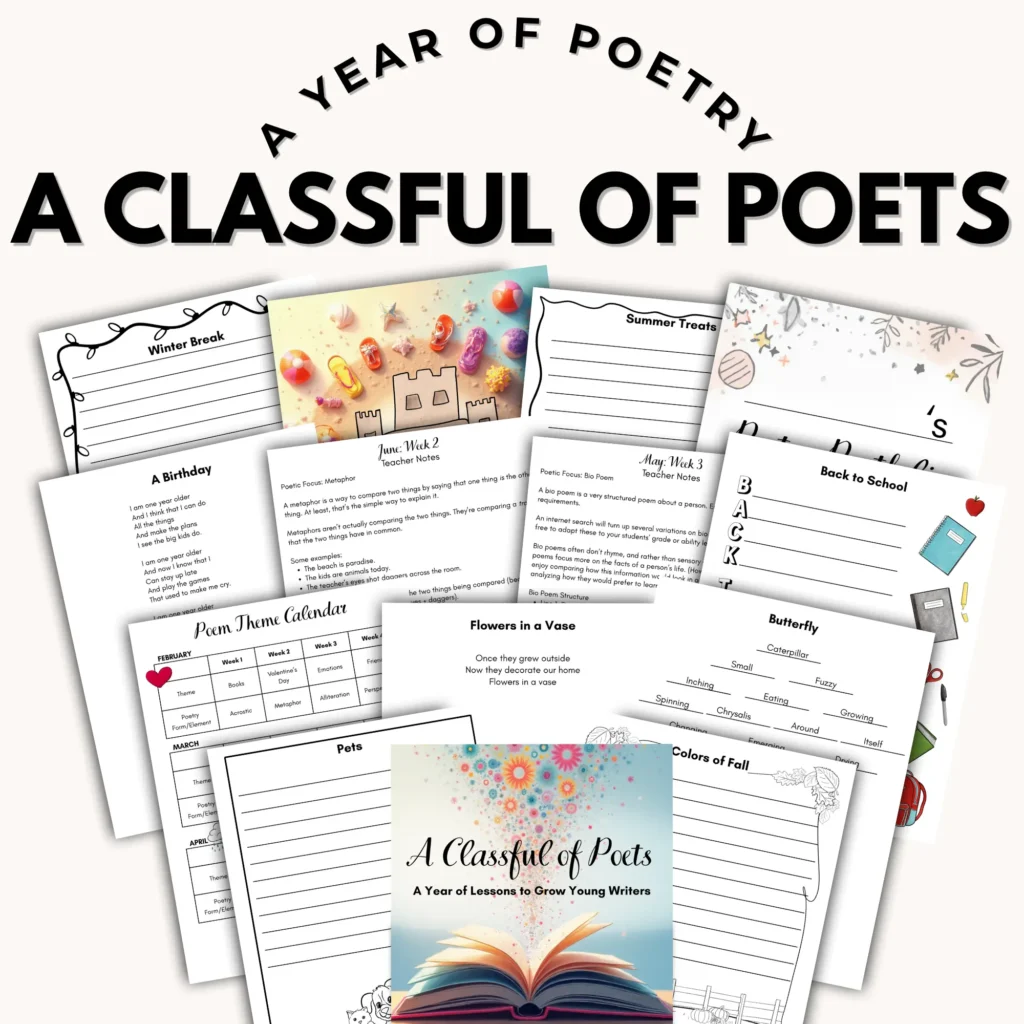
A Classful of Poets has one goal: To give all teachers an easy way to teach poetry every week without it taking over the schedule.
Everything you need is included:
- A teacher’s guide page for every poem
- A unique mentor poem (written by me, so no need to worry about hunting for – or creating – a poem that uses the week’s focus)
- A script to lead the class in a discussion about the poem’s content (what it’s about) and craft (how it’s written)
- A template for student poems, all including an illustrated scene that fast finishers can color when they’re done
You can buy just 3 months at a time and use the lessons for special holidays or a single unit, or you can get the full year.
To really see all of the benefits (increased creativity, stronger relationships, more fluent readers), the full year is best.
The full year has some bonuses, too:
- Poetry portfolio covers
- About the Author templates
- An introduction to figurative language
- A poetry terms worksheet
With A Classful of Poets, you never need to wonder what your next poetry lesson will be. Get it today, and start teaching poetry tomorrow!
Before you comment: Please take a moment to read our community guidelines. We’re building a space that’s welcoming, respectful, and helpful to all!
F.A.Q.
Teaching poetry helps students build reading fluency, think critically, express themselves through writing, strengthen classroom discussions, and connect academic content to memorable language.
Poetry Friday is a weekly classroom routine where students read, discuss, and often write poetry. Instead of treating poetry as a single unit, students experience it in small, consistent lessons throughout the school year.
No. A typical Poetry Friday lesson can be completed in about 20–30 minutes, making it an easy addition to a weekly literacy routine.
No. Poetry Friday works well in elementary and middle school classrooms. Choosing age-appropriate mentor poems and discussion questions keeps the lessons engaging for older students.
Poetry gives students a low-pressure way to experiment with language. Because poems can be short, reluctant writers often feel more comfortable writing a few meaningful lines than an entire paragraph or essay.
Before you comment: Please take a moment to read our community guidelines. We’re building a space that’s welcoming, respectful, and helpful to all!