
- Mistake #1: Choosing Poems That Are Too Difficult
- Mistake #2: Choosing Poems That Are Not Relevant
- Mistake #3: Over-Analyzing Every Poem
- Mistake #4: Forcing Students to Share Before They’re Ready
- Mistake #5: Giving a Quiz on Every Poem
- How to Teach Poetry So Students Actually Enjoy It
- Want a full year of Poetry Friday lessons?
- F.A.Q.
Learning how to teach poetry effectively can feel a little intimidating. You want your students to enjoy the poems they read, understand the techniques poets use, and maybe even come away seeing poetry as something more than another text to analyze for a grade.
The truth is, unless they’re taught otherwise, teachers tend to teach the way we ourselves were taught. (That’s a lot of “teach” words.)
I don’t know about you, but when I was in school, most of our “poetry” lessons consisted of annotating multiple pages of dry stanzas, written in the previous century by old white dudes, and then taking a quiz on it the next day.
We’d do that every week until the “poetry unit” came to an end, and then we’d move onto some other type of text.
Rinse and repeat, every year.
And unless you’ve had better teachers than I did, you’re probably teaching poetry the same way.
This isn’t to say that there’s anything wrong with analyzing poetry. The problem comes when it becomes the entire teaching strategy, leaving no room for appreciating a well-crafted line or realizing the emotional connection the poet weaves.
Poetry can breathe life into a boring topic, bring a smile to our face or a tear to our eye. Poetry can connect across time, space, and culture.
Poetry takes a gigantic topic, or an unspeakable emotion, and distills it down into its rawest, thickest form.
It can cover all your literacy standards, and do it in a way that still leaves you time to play that vocabulary review game.
But if you were never taught (or shown) how to teach poetry effectively, you’re just going to keep repeating the same mistakes of your teachers before you, and this time it will be your own students will be the halls muttering, “This poem’s so stupid. Why do we have to do this, anyway?”
(Related Reading: 5 Benefits of Teaching Poetry)
Once you know how to teach poetry in a way that gives students repeated opportunities to read, discuss, notice, and create, you don’t need to save poetry for one four-week unit every year.
You can make it a regular part of your students’ experience with language.
Mistake #1: Choosing Poems That Are Too Difficult
Young readers, struggling readers, or MLLs can (and should) experience difficult poems, but they need additional support to be successful with them.
Their language struggles don’t mean they should never be challenged, or that they “can’t handle” higher-level poems.
On the contrary, please push these learners to stretch their thinking and broaden their understanding.
But you might need to put some supports in place if the poem you select (or are handed) is significantly above their reading level.
One of my favorite ways to support struggling readers or MLLs is to make a copy of the poem with annotations already in the margins.
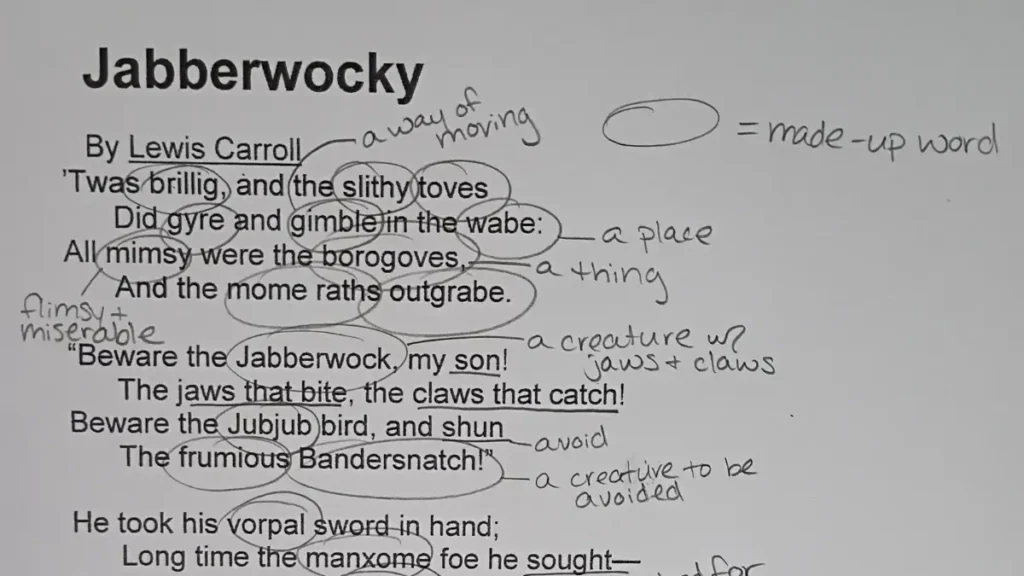
(My style of teaching poetry focuses more on discussion than annotation, so most poems aren’t marked up at all at the end of class.)
For struggling readers, these annotations give them immediate support without lowering the level of the text.
On the surface, the paper looks exactly the same (because it’s the same poem!), but the explanations, definitions, or translations are there to give these students an on-ramp so they can participate in the discussion and appreciate the poem.
Mistake #2: Choosing Poems That Are Not Relevant
Teachers can turn students away from poetry if the poems they choose aren’t relevant to students’ lives.
Think about the last time you were in a staff meeting and the presentation focused on a grade level or subject you don’t teach. You probably used the time to catch up on some grading, or at least a quick catnap, right?
I want to be clear: Relevant doesn’t mean every poem has to precisely mirror your students’ lives, situations, or identities.
A lot can be learned from reading others’ experiences or perspectives.
But young or inexperienced readers aren’t used to making connections between the poem and their own lives. You (the proficient reader in the room) need to make those connections for them.
When you select a poem that seems (on the surface) to not connect to students’ lives at all, tell them why you’re picking it.
Maybe the poem is funny (once they understand the double-meaning words). Maybe the poem describes a common emotion, even if the situation is different.
Students in landlocked states can understand the terror of a hurricane, but only if you show them how the author builds suspense and emotion over the course of the poem.
Mistake #3: Over-Analyzing Every Poem
I’ll be blunt: In my sixteen years of experience, I have not seen students effectively remember lessons or skills they learned only once.
With poetry, the common way to teach it is to build a unit around grade-level poems and poetry standards, then teach that unit for 4-6 weeks. Most students complete some sort of poetry portfolio or project, and then the class moves on.
However, the following year, when the teacher brings up hyperbole, irony, symbolism, or rhyme scheme, most students give them a blank stare, as though they’ve never heard of these terms.
They have – but their brains weren’t given the opportunity to practice or work with these concepts long enough to cement them into long-term memory.
Instead, I suggest teaching poetry through bite-sized discussions.
If you stop trying to cram every skill into one unit but instead spread the experience out over the course of the school year, suddenly you have all the time in the world to get students to understand how rhythm connects to rhyme or how poets build a metaphor that lasts throughout an entire poem.
(Related Reading: 20 Poetry Discussion Questions That Get Students Talking)
You’re no longer pressured to squeeze every bit of analysis out of each poem, because chances are there will be another poem with those same features in a few weeks.
Want to Try Poetry Friday?
If the idea of teaching poetry in smaller, more manageable doses sounds appealing, I’ve created four ready-to-teach Poetry Friday lessons for grades 3–6. Each one includes a mentor poem, a teacher-friendly lesson script, and a student template, so you can try the Poetry Friday rhythm without having to plan the whole thing from scratch.
Get the Free Fall Poetry Friday Lessons
Mistake #4: Forcing Students to Share Before They’re Ready
Poetry can be very personal, and forcing students to share their poems (either out loud or by turning them in) can cause them to shut down.
Some students may withhold feelings from their poems because they are self-conscious or embarrassed.
Others may shut down and refuse to share.
I always made sharing an option at the end of our Poetry Friday sessions, but it was never required.
Students could bring me their poems for feedback, and I always found something positive to say.
I would rather build students’ confidence and belief in themselves than force them to stand in front of their peers and read their innermost thoughts out loud.
Mistake #5: Giving a Quiz on Every Poem
Poetry – both the writing and the interpretation – is subjective, and subjectivity is difficult to grade.
I remember reading an article about a poet whose writing was used in a standardized test, and when she received the questions, she couldn’t even answer them correctly – about her own poem!
Let me put this another way: Have you ever returned to a place you used to visit long ago, and even though the place is the same, it feels different? Or have you ever reread a favorite book and gotten a completely different message out of it? Or understood a character in a new way, thanks to your own life experiences?
There isn’t always one single “right” interpretation of a poem, but students should be able to support their interpretations with evidence from the text.
(For example, one of my students once picked out the first letter of every line and tried to say it was significant. The letters formed a complete nonsense word, so…no, not actually significant.)
Unless you wrote the poem (and if you did, well done, you!), it’s not for you to pass judgment on whether a student’s interpretation is correct or not.
I do want to acknowledge the tests that students often take that include poems as one of their text types. In this case, there is a “right” answer and a “wrong” answer.
But this doesn’t mean every poem needs to be analyzed and quizzed to death. That’s what sucks the joy out of poetry, and that’s what turns students away from loving poems as a text format.
How to Teach Poetry So Students Actually Enjoy It
So, how do you actually teach poetry in a way that students enjoy?
Instead of teaching one comprehensive poetry unit per year and calling it a day, make poetry a regular part of your classroom routine.
Once per week (or broken into even smaller chunks throughout the week if that fits your schedule better), present students with a new, relevant poem.
Read it to them. Ask what they notice.
Point out one element of poetic craft or structure.
Have a conversation about the content.
Invite them to write their own poem.
After a few weeks of this, you’ll be surprised at how much that initial discussion takes off.
(Related Reading: Poetry Friday Schedule: How Long Should it Take?)
Want a full year of Poetry Friday lessons?
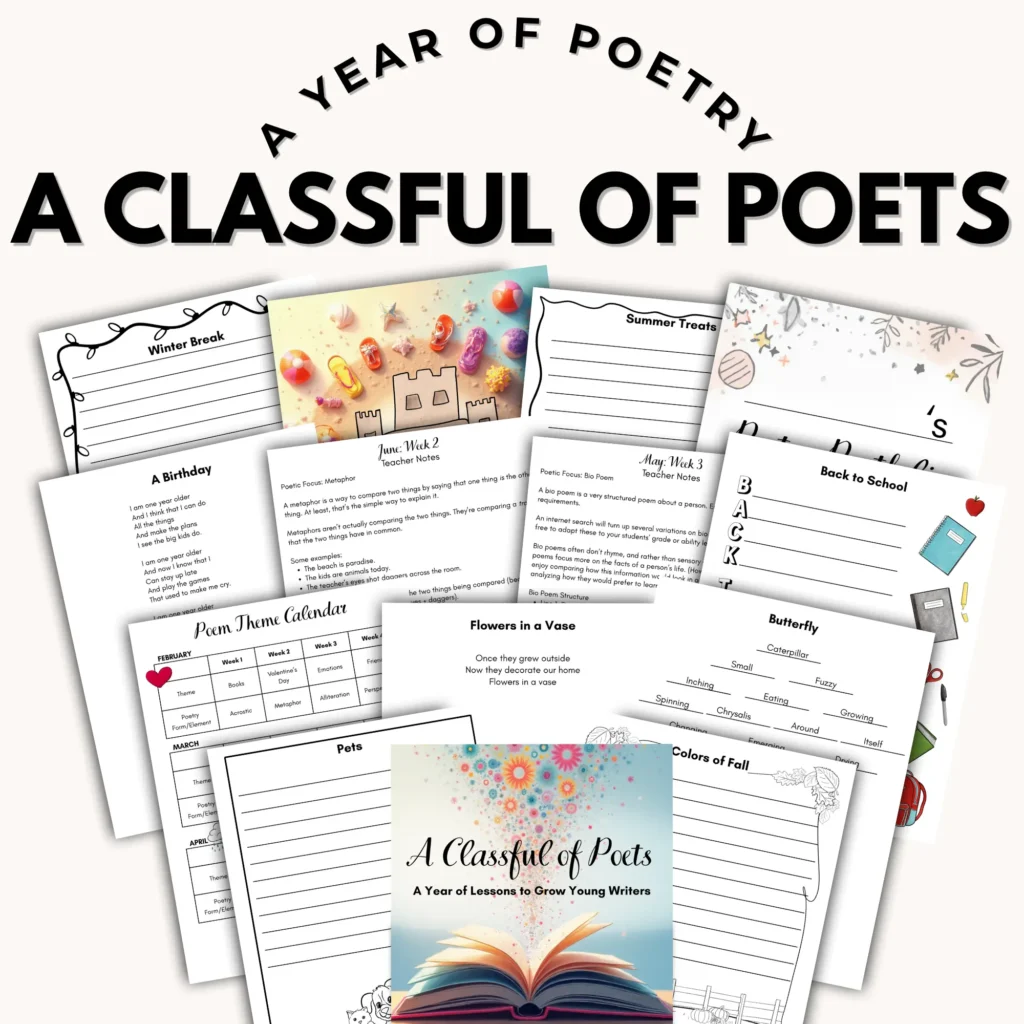
That’s exactly why I created Classful of Poets: a yearlong collection of ready-to-teach poetry lessons designed around short, engaging Poetry Friday sessions rather than one giant poetry unit.
Instead of spending weeks squeezing every possible literary device out of a handful of poems, you’ll have a steady stream of poetry experiences you can use throughout the school year.
Before you comment: Please take a moment to read our community guidelines. We’re building a space that’s welcoming, respectful, and helpful to all!
F.A.Q.
A good way to teach poetry is to make it a regular part of instruction rather than limiting poetry to a single unit. Read short, engaging poems with students, discuss what they notice, explicitly teach one element of poetic craft, and give students opportunities to respond and create their own poetry.
Choose poems that are interesting and relevant to your students, and give them opportunities to talk about what they notice and think rather than requiring them to analyze every line. Humor, surprising word choices, strong imagery, and poems connected to familiar experiences can all help students engage with poetry.
Rather than teaching poetry for several consecutive weeks and then moving on, consider incorporating short poetry lessons throughout the school year. A weekly Poetry Friday routine, for example, gives students repeated opportunities to encounter poetic language and practice skills over time.
Struggling readers can absolutely read challenging poetry when appropriate scaffolds are provided. Consider pre-teaching unfamiliar vocabulary, providing annotated copies of difficult poems, reading the poem aloud, and discussing the text before asking students to work independently.
Not every poetry experience needs to be graded. Poetry can be used for discussion, exploration, reading practice, and creative expression without a quiz or formal grade. When assessment is necessary, focus on skills students can demonstrate, such as identifying poetic techniques or supporting an interpretation with textual evidence—rather than grading a student’s personal response to a poem.