
Brain breaks are short classroom activities designed to help students refocus, regulate their energy, and return to learning more successfully.
And chances are, even if you already understand the importance of brain breaks, you’re still unsure about when to use one.
Use a brain break too early, and it might interrupt productive learning. Use one too late, and students may already be too distracted, disengaged, or overly energetic to refocus.
After all, if you use a brain break at the wrong time, it could just make things worse…right? Not exactly.
In this post, I’ll show you 5 common signs your class needs a brain break…plus the secret that keeps brain breaks from backfiring, even if you use the “wrong” one at the “wrong” time.
- Noise Level Rising: An Audible Sign Your Class Needs a Brain Break
- Heads on Desks or Hands: A Visible Sign Your Class Needs a Brain Break
- A Long Time Sitting: A Proactive (or Reactive) Opportunity for a Brain Break
- Disengaged Students: What to Look For
- Distracted Students: What to Notice (and What to Ignore)
- Bonus Tips: How to Know if Students are Taking Advantage of Brain Breaks
- The Secret of Brain Breaks
- F.A.Q.
Noise Level Rising: An Audible Sign Your Class Needs a Brain Break
One of the easiest ways to tell that your class needs a brain break is by the general noise level of the room.
A rising noise level shows that students are excited and energized. This might be a good thing: If you’re working on an engaging group project, perhaps you want noise, excitement, and energy in your classroom.
But if students are working on an independent task or a low-energy assignment, hearing them start to shout over each other could indicate that they’re losing focus.
This would be a good time to get students’ attention and complete a brain break.
Sample script:
“Class, I’m noticing that the noise level is getting higher and higher. This is making it hard for classmates to concentrate on their work, so we’re going to take a quick brain break.”
Heads on Desks or Hands: A Visible Sign Your Class Needs a Brain Break

Students tend to look at what they’re focusing on. If their heads start drooping, it’s a sign that their attention is falling as well.
If only a few students have their heads lowered, you can redirect them individually with proximity (standing nearby) or light taps on their desks.
But if most students have their heads lowered, it would be a good time for a brain break.
Sample script:
“Class, it seems like you’re having a hard time staying awake and focused on the activity we’re doing. I know it’s early in the morning, but this assignment is an important one. We’re going to do a quick brain break to wake your brains back up. Everyone stand up, please!”
A Long Time Sitting: A Proactive (or Reactive) Opportunity for a Brain Break
There are plenty of reasons to ask students to sit for a long time:
- Benchmark testing
- Yearly testing
- Long bus ride for a field trip
- Assembly
Even a regular lecture in a middle school classroom can feel like forever for an 11 or 14 year old.
If students are going to be sitting for a long period of time, you can set them up for success by giving them a movement-based brain break before the activity starts.
On the other hand, if students have already been sitting for a long time, don’t expect them to give their full focus to whatever comes next!
Make sure to give them a stretch break, a movement break, or a brain break before asking them to reengage.
Sample script: proactive brain break before sitting
“Class, in just a moment, we’re going to go to the gym for an assembly. It’s going to be a pretty long one, and you’re going to be sitting for a long time. Let’s do a quick brain break now so your brain is “locked in” and ready to focus.”
Pro Tip: Don’t say “locked in” unless that fits your teaching style. Using student slang can backfire if your students think you’re trying too hard to be cool.
Sample script: reactive brain break after sitting
“Class, I know you just finished a really long test session. You did a great job staying focused, and I know you were all trying your best. Unfortunately, we have one more test to do today. Let’s take a quick brain break to get your brains refocused so you can try just as hard on this last test.”
Disengaged Students: What to Look For

Sometimes students might be disengaged without giving a clear visible sign like putting their heads down.
If you’ve asked students to complete a simple direction several times, they might need a brain break.
Sample script:
“Class, I’ve had to ask you to take out your books several times. This is a simple direction that shouldn’t be taking so long, so we’re going to do a brain break to refocus our attention back to the classroom and my teaching. After this brain break, I expect you will pay closer attention and follow my directions the first time they’re given. Everyone stand up, please.”
Pro tip: If only a few of your “frequent flyers” need repeated directions, this might be more of an executive functioning struggle these students are dealing with. But when students who normally comply are also failing to follow directions, then it’s time to use a whole-class intervention.
Distracted Students: What to Notice (and What to Ignore)

Students – especially upper elementary or middle school students – might be distracted without being disengaged.
The fascinating thing about attention and focus is that it’s always aimed somewhere. If students aren’t paying attention to you, it means they’re paying attention to something else.
They might be paying attention to their friend across the room, or to a garbage truck outside the window.
You’ll know they’re distracted because they’re asking the same question multiple times (especially if you’ve answered it already) or they’re holding frequent side conversations – sometimes even during your teaching!
If only a few students are displaying these behaviors, it might not be worth stopping the momentum of the entire class just to address the actions of a few students.
But if students who aren’t normally distracted are having side conversations or trying to get the class off track, then it’s time for a brain break.
Sample script:
“Class, it seems like you’re having a really hard time focusing today. Go ahead and put your pencils down for a moment. We’re going to take a quick brain break to get ourselves back on track. Everyone stand up!”
Pro Tip: If you’ve just done a brain break and your class is already showing signs of distraction, try ignoring the behavior instead of rushing into another brain break. See the next section to know if your students are taking advantage of brain break times.
Related Resource: If you want a free set of classroom-tested brain breaks organized by student energy level, you can grab my set of free Brain Breaks That Work here.
Bonus Tips: How to Know if Students are Taking Advantage of Brain Breaks
Kids are crafty. If they believe brain break time will take away from hard work or high expectations, they will absolutely choose to display behaviors that will get them a brain break.
(Related Reading: Why Your Brain Breaks Aren’t Working With Older Students)
Here are some things to watch out for so brain break time remains a tool…not a toy.
Brain breaks should get the effect that you want.
If students don’t refocus, it’s worth evaluating your brain break style to make sure it’s still effective. Make sure the brain breaks are not lasting longer than 5 minutes (30 seconds to 2 minutes is best), and make sure students know exactly what is expected of them before, during, and after the brain break.
Students should transition quickly out of brain breaks.
If students are slow to return to their seats or leave their partners (for partner brain breaks), they are treating brain break time as social reward time. You can fix this by being extremely clear in your expectations for post-brain-break transitions, or by eliminating partner brain breaks until your students show they can handle the responsibility again.
Students should not treat brain breaks like a reward.
If students are constantly asking for brain breaks – not because they have identified that they need them, but simply because they want to get out of their seats and hang with friends – then they are taking advantage of brain break time. You can solve this by not letting students pick the time or type of brain break. You might also ask them why they want a break. If their answer doesn’t reflect a need to refocus, they don’t get to have a brain break.
The Secret of Brain Breaks
As promised, I want to tell you the secret to using brain breaks effectively. Once you know this secret, you won’t have to worry about picking the “wrong” brain break or even using it at the “wrong” time.
Brain breaks are energy equalizers.
If your class is highly energetic and distractable, a calm brain break will help them settle.
On the other hand, if students are lethargic and distracted, a more energized brain break will help them wake up and focus.
There are several excellent brain breaks I recommend, but any of them can be used at any time.
The teacher’s level of energy before, during, and after the brain break has more influence on the brain break’s success than the type or time of the brain break.
(Related Reading: How to Use Brain Breaks Without Losing Classroom Control)
When your class is energetic, give brain break directions in a calm, even tone.
If the class is sleepy, make your voice animated and use big gestures.
Match their energy…but in reverse.
The more tired they are, the more animated you become. The more excitable they act, the calmer you speak.
This concept might be easy to understand, but it’s hard to implement. That’s why I created the Brain Breaks Routine Builder.
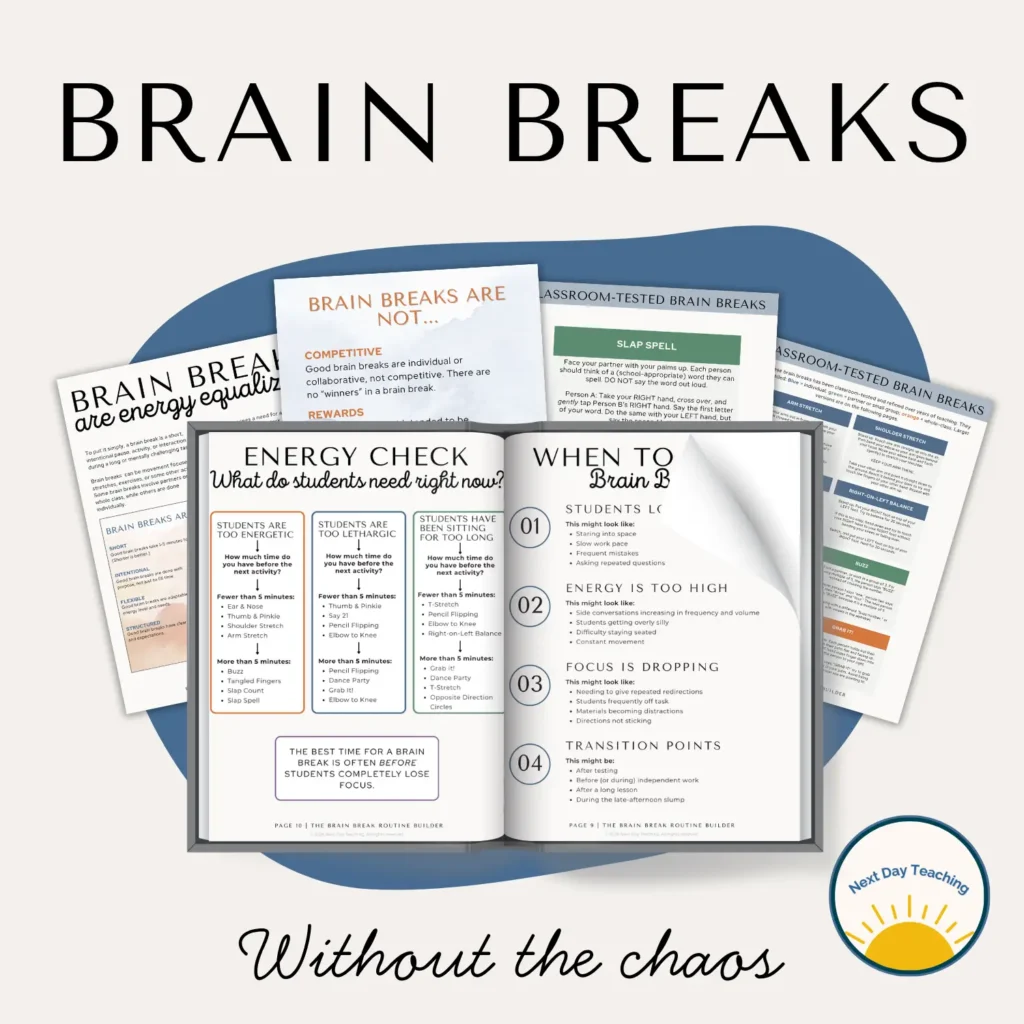
It’s a set of scripts, schedules, trackers, and routines – plus 8 classroom-tested brain breaks I haven’t talked about anywhere else – to help you use brain breaks consistently in your classroom…without losing instructional time.
F.A.Q.
Some common signs include rising noise levels, distracted students, repeated directions, heads on desks, and difficulty staying focused during lessons. Brain breaks help students reset their energy and attention so they can return to learning more successfully.
As often as needed, unless students are taking advantage of the time. Some teachers use brain breaks proactively before long periods of sitting, while others use them reactively when students begin losing focus or becoming overly energetic.
Brain breaks can become disruptive if expectations are unclear or transitions are unmanaged. Clear routines, short time limits, and calm teacher directions help brain breaks stay productive instead of chaotic.
Common signs include lowered heads, slow responses, repeated questions, side conversations, and difficulty following simple directions. These behaviors often indicate that students need a chance to reset and refocus.
Not at all. Older students and middle school students also benefit from brain breaks, especially after long periods of sitting, testing, or intense concentration. The key is choosing age-appropriate activities and maintaining clear expectations.
Brain breaks help students regulate their energy, refocus attention, improve engagement, and return to learning more effectively. They can also support smoother classroom transitions and reduce off-task behavior.
Before you comment: Please take a moment to read our community guidelines. We’re building a space that’s welcoming, respectful, and helpful to all!