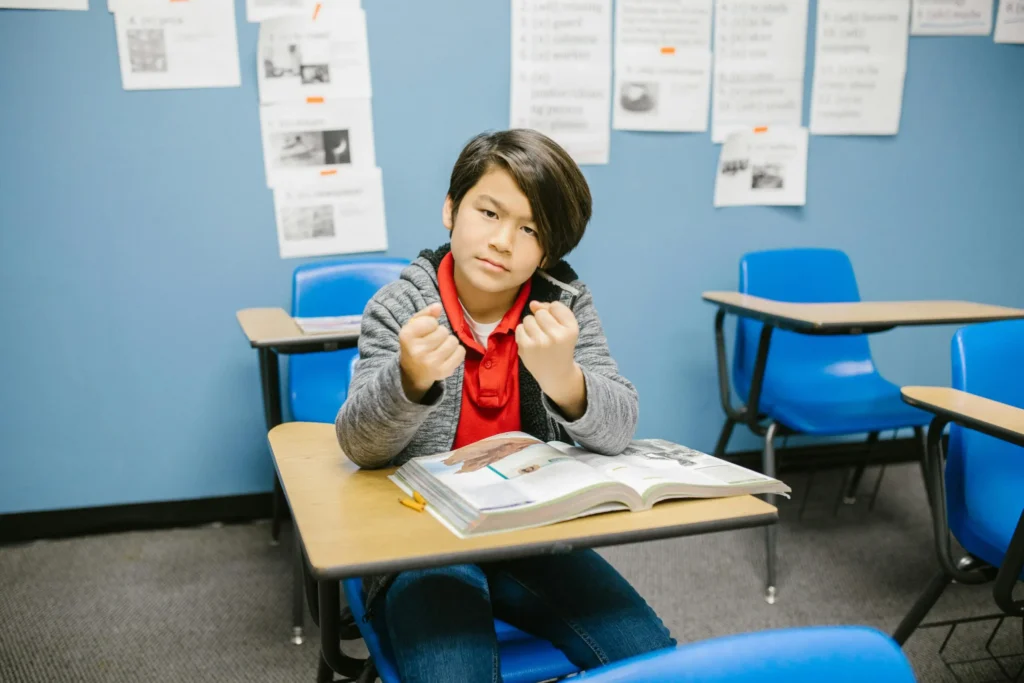
When a student raises their hand, it can be difficult to know whether they have an answer to your question…or if they’re about to ask to go to the bathroom. A clear bathroom hand signal in the classroom helps you immediately know whether a student has a question or needs to leave the room.
The best bathroom hand signal for the classroom is crossed fingers with eye contact. This allows students to request a bathroom break silently while the teacher gives permission with a nod…without interrupting instruction.
- Why Most Classroom Bathroom Signals Don’t Work
- Why Using a Raised Hand as a Bathroom Signal Causes Disruptions
- The Best Bathroom Hand Signal for the Classroom: Crossed Fingers
- How to Teach and Use a Bathroom Hand Signal in Your Classroom
- Why This Bathroom Hand Signal Works (Grades 4-5)
- Real-World Example: How I Used Crossed Fingers in a 4th Grade Classroom
- Want More No-Prep Ways to Calm Your Classroom?
- F.A.Q.
Why Most Classroom Bathroom Signals Don’t Work
Here’s what happens in most classrooms:
- The teacher asks a discussion question
- Several students raise their hands
- The teacher calls on a student
- Instead of answering the question, the student asks, “Can I go to the bathroom?”
Now the teacher has a decision to make: Allow the student to leave (addressing their need but slowing the discussion progress) or ask the student to wait (possibly causing an argument and further derailing the discussion).
Either way, not only does the discussion lose momentum, but the teacher is put on the spot, having to make an immediate decision whether the student is allowed to leave or not.
Why Using a Raised Hand as a Bathroom Signal Causes Disruptions
Any time an off-topic comment is made – even something as brief as a bathroom request – instructional time is lost.
It takes time to answer a student’s request…prompt them to sign out…regain the class’ focus…and continue the discussion.
And if your classroom is anything like mine, the instant you let one student leave the room, suddenly everyone needs to go to the bathroom.
It would be better if you knew, without a doubt, that a raised hand only signals an on-topic question or comment.
The Best Bathroom Hand Signal for the Classroom: Crossed Fingers

Instead of having students raise their hands to request a bathroom break, have them cross their fingers instead. (I taught my students that this was sign language for letter “r,” as in “restroom.”)
Students may choose to raise their hands with crossed fingers, or they may keep their hands closer to their desks if they’re feeling self-conscious.
However, their crossed fingers must be visible, and they must be making eye contact with the teacher.
Here’s what happens now:
- The teacher asks a discussion question, and their eyes scan the room
- Several students raise their hands, but one student has crossed fingers
- The teacher returns eye contact with the student whose fingers are crossed and gives a nod
- Without talking, the student gets out of their seat and follows the bathroom signout procedure
- Meanwhile, the teacher calls on a different student who did not have crossed fingers
- The discussion continues, and most students are unaware that a classmate has left the room
Related Reading: 5 No-Prep Classroom Management Strategies You Can Use Tomorrow
How to Teach and Use a Bathroom Hand Signal in Your Classroom
Quick Start Teaching Guide
- Teach students: crossed fingers = bathroom
- Require eye contact
- Nod = yes, head shake = no, finger up = wait
- Continue teaching without interruption
Make sure students know that they must be looking at the teacher when they cross their fingers. If they just put their hand in the air and look at their desk…or the wall…or their friend, the teacher cannot indicate whether the student has permission to go or not.
Sometimes it’s not a good time for a student to leave the classroom.
- Another student might already be in the bathroom
- There might be a fire drill coming up
- You might be in the middle of giving important directions
In those cases, give a head shake instead of a nod. This means “Not right now. Please wait and ask again later.”
Sometimes you might hold up one finger to indicate a brief time the student needs to wait. For example, as soon as a student comes back from the bathroom, or once you finish giving directions.
All of this can be accomplished nonverbally, though the student must be maintaining eye contact in order to receive the message!
Pro Tip: Set clear expectations about how often students can (and should) be using the bathroom. Expect more trips than usual when you first introduce this signal because it’s new and exciting.
(Related Reading: 9 Essential Classroom Procedures and Routines for the Beginning of the Year)
Why This Bathroom Hand Signal Works (Grades 4-5)
Using crossed fingers instead of a raised hand minimizes disruption to your lesson or activity. You can let three students go to the bathroom, all without directly saying a word, while the rest of the class completes a lesson or assignment.
Your instruction is not interrupted, and students still have their needs met.
Additionally, students in upper elementary grades are ready for more independence; they don’t need a class bathroom trip like in the primary grades.
Finally, most students benefit from explicit practice with situational awareness and making eye contact. Once students realize that if they’re not looking at you and paying attention, they won’t get to use the bathroom, they start to pay attention more in other areas as well.
Related Reading: The Best Bathroom Procedure for Middle School Classrooms
Real-World Example: How I Used Crossed Fingers in a 4th Grade Classroom
In my second year of teaching, I had a combined class of 3rd and 4th graders. The students I’d had as 3rd graders the previous year looped up and had me as a teacher for a second year in a row.
Around midday on the first day of school, a 4th grade student subtly crossed his fingers and placed them on his desk, looking directly at me.
I laughed, because I hadn’t even gone over the bathroom procedure yet. This student showed me that simple, consistent procedures stick…and save time year after year.
I nodded to let him go to the bathroom…and made a mental note to go over the bathroom signal earlier in the day next time!
Pro Tip: Make this bathroom hand signal part of your Classroom Management Plan!
Want More No-Prep Ways to Calm Your Classroom?

F.A.Q.
A bathroom hand signal is a nonverbal way for students to request a bathroom break without interrupting instruction. Instead of raising their hand and speaking, students use a specific gesture, like crossed fingers, to communicate their needs.
The best bathroom signal is one that is silent, visible, and easy to recognize. Crossed fingers paired with eye contact works well because it allows the teacher to give permission nonverbally while continuing the lesson.
Teach a consistent nonverbal signal and practice it with students. Reinforce that raised hands are only for questions or comments, while the bathroom signal is used silently with eye contact.
Not always. Teachers can use nonverbal responses, like a head shake or “wait” signal, to indicate when it’s not a good time, such as during instructions or when another student is already out.
Before you comment: Please take a moment to read our community guidelines. We’re building a space that’s welcoming, respectful, and helpful to all!