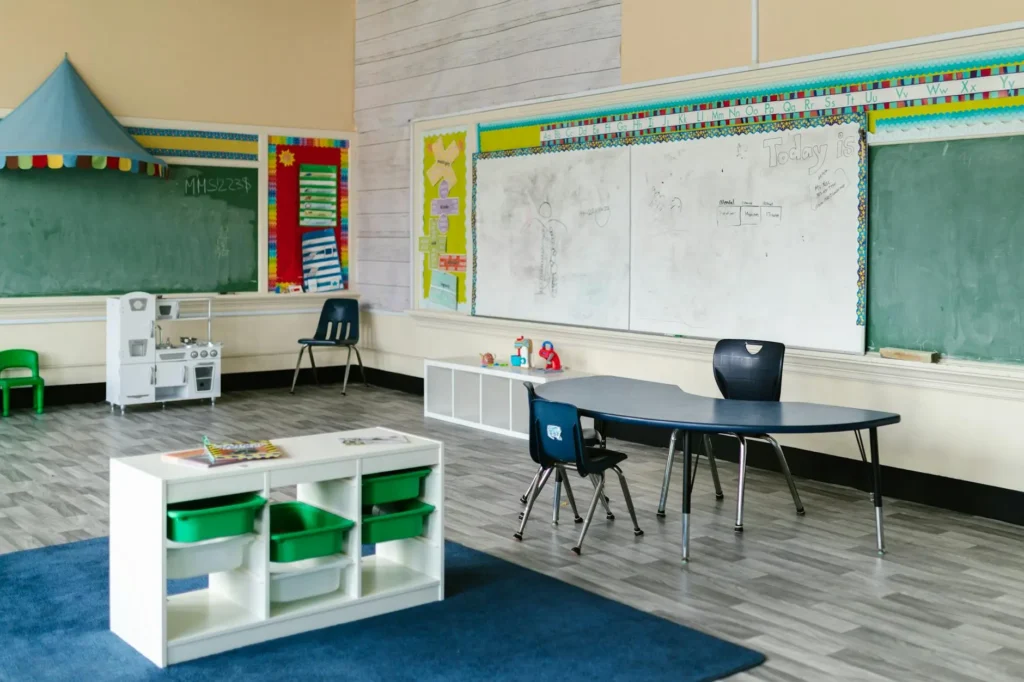
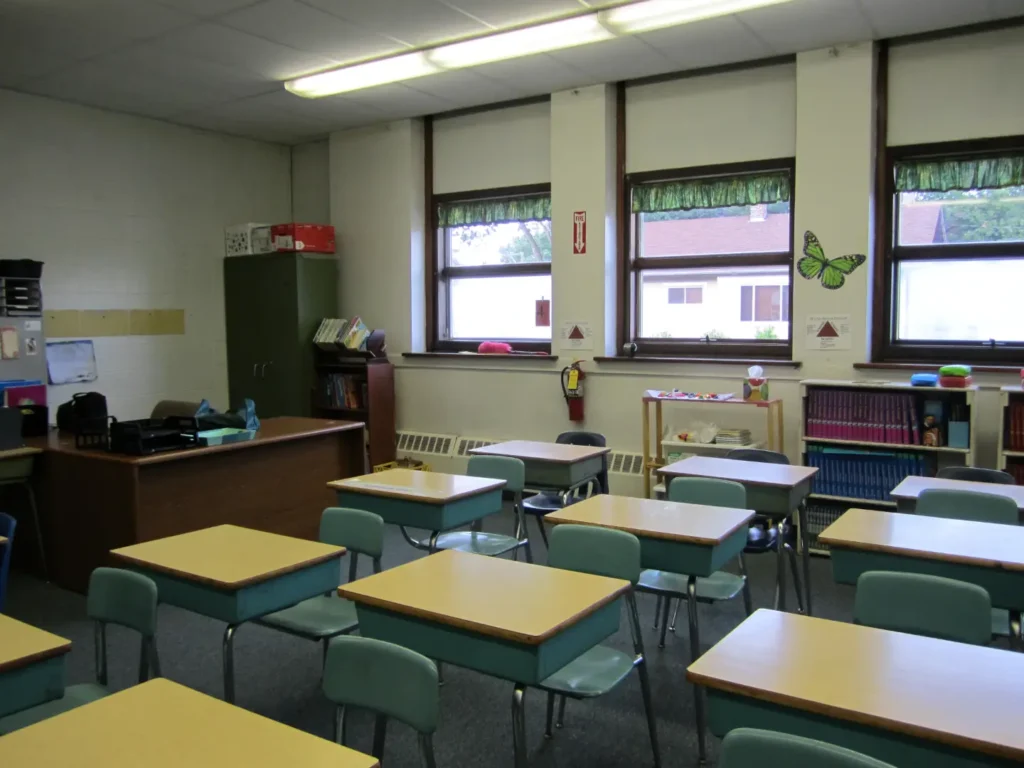
If you’re looking for classroom setup ideas, you’re probably overwhelmed with all the decisions you need to make. There are supplies to order, empty walls to cover, and furniture to assemble.
You spend your days asking yourself questions like: Where should student desks go? What is actually essential to get for the room? How can I decorate my classroom when I have no budget?
Those are all great questions, but there’s something even more important new teachers should ask: How will this classroom setup affect student behavior?
(Related Reading: How Your Back-to-School Bulletin Board Affects Your Classroom Management)
The way you arrange your classroom can make routines easier, reduce unnecessary interruptions, and help students understand how your classroom works.
Classroom setup is not just about creating a space that looks good. It’s about creating a space that supports classroom management from day one.
Before you start moving furniture around, remember that your classroom setup is your first classroom management decision. Every time students need to move, get supplies, ask a question, or complete a routine, your room either makes that easier or creates another opportunity for distraction.
Whether you are setting up your first classroom, moving to a new grade level, or trying to improve a room that never quite felt functional, these classroom setup ideas focus on one goal: creating a classroom where students can learn, move, and follow routines more easily.
Classroom Desk Arrangement Ideas for the First Weeks of School
There’s something about the look of student desks in rows that screams “school.” Maybe it’s all the clipart and stock images floating around, or maybe our minds never evolved past the 1950’s.
Regardless of the reason, the truth is that when students are sitting in rows, all facing the front of the room, they’re less likely to talk to each other or get distracted.
On a practical note, papers are often easier to pass out when students are sitting in rows. And the beginning of the year often involves passing out a lot of papers.
If your classroom has the space, try to make each student desk its own island, not touching the desks on either side. If you’re short on space, you can push two or even three desks together side by side.
Keep the desks this way for a week or two. Then arrange student desks in groups of 3-4.
There are several good reasons for keeping student desks in groups for most of the year, but the one most important for the beginning of the year is Hell Week.
(“Hell Week” is just what I call it. Your school – or your mentor – may have a different name for it.)
Hell Week usually happens about 3 weeks into the school year, though your experience may vary.
It’s a time when students have started to settle into the routine of school and they’re comfortable enough to start testing boundaries.
You’ll notice students shouting out, leaving their seats without permission, and being generally disruptive.
When that happens, and if their desks were moved into groups, you can put the desks back into rows…which feels like a punishment.
As soon as they settle down (I promise, they will), their desks can go back into groups again.
And for the rest of the year, all you have to do is ask, “Do we need to put desks in rows, or can you keep your comments to yourself?” and they will shape up.
Label All Student Desks with Student Names (yes, even in middle school)
When you’re putting desks in rows, make sure to label each desk with the student’s name.
This is more common in upper elementary grades, but often middle school students change classes. One desk might be shared between five or six students throughout the day, so labeling each desk with a permanent student name label is impractical.
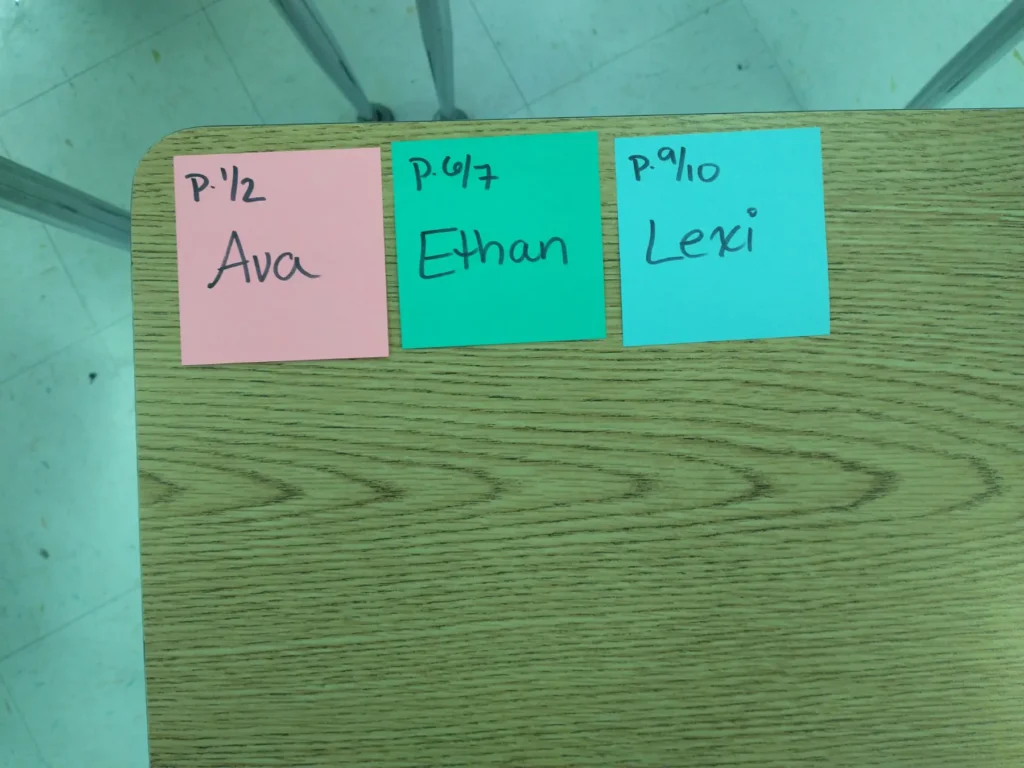
My favorite trick is to use sticky notes, color-coded to match each class period, to make things easy.
Each class period got assigned a color. That was the color marker, folder, and yes, sticky note, that I used for that class period all year.
Before the first day of school, I wrote student names on the sticky notes and put them on the desks in the classroom.
If a desk was shared among multiple class periods, the desk had multiple sticky notes.
Check it out!
This did a couple of things.
First, and most importantly, it made sure each student knew they belonged in my classroom.
The sad truth is, some students don’t have a place where they feel like they belong. By putting their name on a desk, I was telling them that they belonged in my classroom. They had a place with me.
Second, it made learning names much easier. Instead of having to consult my seating chart every time I wanted to call on a student, I could casually saunter over and peek at the sticky note.
By the end of the first week, I was able to match most student faces with names, and the sticky notes could come off the desks.
Arrange the Room with Student Traffic in Mind
As you’re setting up the desks in the room, consider student traffic patterns and mobility.
If you have students with mobility supports such as crutches, walkers, or wheelchairs, you’ll need to pay extra attention to walkways and available space.
However, even if everyone in your classroom walks unassisted, traffic flow is still important to consider.
Think about places students will visit unassisted. These are areas like cubbies, student mailboxes, the pencil sharpener, the garbage can, and any other space where communal supplies are stored.
These spaces should be as free from other furniture as possible. Ideally, there should be enough space for a group of students to cluster in the area without feeling cramped.
Try to minimize distractions and temptations in these spaces. If there’s a stapler or a tray of paper clips next to the trays where students turn in their homework, there’s a good chance that someone will bend a paperclip or use the stapler.
This isn’t a bad thing; it just means that students need to be taught how to use these tools appropriately. Consider adding those skills to your beginning-of-the-year expectations and procedure lessons.
Something I learned the hard way was to not put the garbage can by my desk.
It seemed convenient at the time, especially since I often ate lunch at my desk. The garbage can was right there for me to throw away my trash.
However, students also found the trash can, and I became uncomfortable with the number of them that gathered around the personal belongings I had at my desk.
Plus, by about 1 pm the food in the garbage can got really smelly. It was bad enough when the can was across the room; having it right next to my desk made the smell even worse.
Classroom Setup Ideas that Help Your Classroom Management
As you’re considering your back-to-school classroom setup and furniture arrangement, think beyond how closely your classroom will match the Pinterest Ideal.
Think about where students will actually walk during the day: is there enough space?
Think about where students will be unsupervised: is the area free from distractions?
Do students have a place in your classroom? Do they know they belong?
Classroom management starts before your students even walk into the classroom. Classroom management starts with the setup of the classroom itself.
(Once your room is set up, effective teachers start planning their classroom procedures and routines. Check out the 9 most essential procedures and routines to teach in this blog post.)
F.A.Q.
Many teachers find that rows or individual desk arrangements work well at the beginning of the year because they reduce distractions and make it easier to teach routines. Once students understand expectations and procedures, desks can be moved into groups or other arrangements that support collaboration.
Classroom setup affects how students move, access materials, complete routines, and interact with each other. A well-planned classroom arrangement reduces unnecessary interruptions and helps students become more independent because they know how the room works.
There is no single best classroom arrangement for every teacher or grade level. Many teachers begin the year with desks in rows to establish routines and then move students into groups once expectations are clear.
New teachers should consider student movement, supply locations, visibility, classroom procedures, and whether students have clear spaces for learning. A classroom should be designed around how students will actually use it throughout the day, not just how it looks.
Focus on function before decoration. Prioritize student seating, organization systems, labels, procedures, and easy access to materials. A classroom does not need expensive decor to feel welcoming and effective.
Before you comment: Please take a moment to read our community guidelines. We’re building a space that’s welcoming, respectful, and helpful to all!