

Do your older students roll their eyes when you ask them to participate in a brain break? Do they groan? Or worse…do they just stare?
If so, the problem might not be brain breaks themselves. It might be the type of brain breaks you’re using—or the way they’re being introduced.
(And if you’re looking for brain breaks specifically designed for grades 4–8, I’ve put together a free set of teacher-tested brain breaks. You can grab here.)
There are several reasons older students resist brain breaks.
They might resent the lack of autonomy. They might be looking to fit in with a peer group. Or the activity might come across as juvenile.
The good news is that most of these issues are completely fixable.
With a few small adjustments, you can run brain breaks for older students without the complaints, eye rolls, and backtalk.
Why Brain Breaks for Older Students Can Feel Too Childish
Any internet or AI search will return an abundance of brain break options.
The trouble is that many brain breaks are intended for younger students.
Movement-based brain breaks like “walk like a monkey” or “wiggle like a noodle” make older students roll their eyes.
Bright colors and catchy songs might have worked when they were eight. But now that they’re 13, they’re “too cool” for those baby brain breaks.
Solution
Find brain breaks that are specifically designed for upper elementary or middle school students.
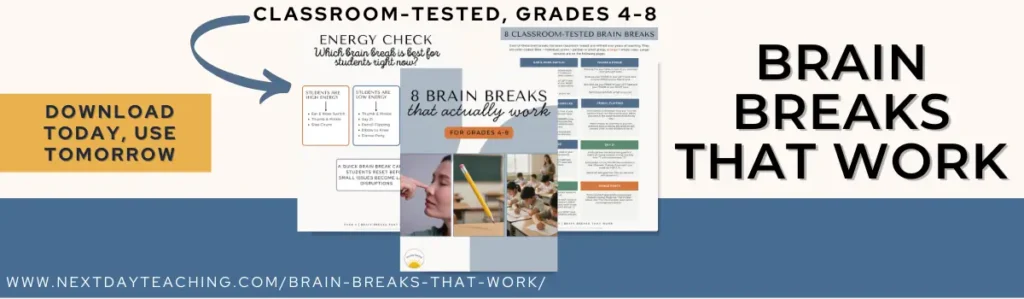
I put together a free resource called Brain Breaks That Work for grades 4-8 after having this same problem in my own classroom.
The activities inside still promote movement and refocusing exercises, but they assume a level of coordination that older students are capable of.
Some of them can be a challenge to complete, and older students typically respond well to “bet you can’t” style challenges (especially when they think it’s their idea to succeed).
Why Some Brain Breaks for Older Students Fall Flat
Primary students will do just about anything the teacher asks them to do.
If the teacher says, “Ok, we’re doing the Hokey Pokey to get our wiggles out,” those kids are moving and shaking before the music has started.
Older students are starting to question their world and the authority figures in it.
Psychologically, this is a good thing! It means their brains are forming their own opinions and deciding who and how they want to be.
But in the moment, it can be frustrating when all you want to do is get through a lesson without Sam shouting out, “Why do we have to do this?”
Solution
Older students tend to respond well to confidence and competence.
They can sense when a teacher doesn’t fully believe in the benefit of the brain break, and they’re quick to take advantage of shaky instruction delivery.
Before you present a brain break to your older students, make sure you know exactly what you want them to do.
Explicitly tell them where they should go, what they should do, how they should stand, and more.
The clearer you make your brain break transition, the smoother the brain break itself will go.
Peer Pressure Can Make Brain Breaks for Older Students Harder
Along with questioning “why we have to do this” every five minutes, upper elementary and middle school students are looking for ways to fit in with their peers.
If the ringleaders of your classroom decide that brain breaks are not for them, the rest of the class will be quick to follow their lead. (You’ll know who the ringleaders are because they’re the ones who always get the rest of the class off task)
Solution
Try to get these students on your side, if you can.
Explain the reasoning behind the brain breaks. (Often ringleaders respond well to logic and “behind-the-scenes” explanations; it helps them feel like they’re more in charge because you’re giving them insider knowledge.)
Be honest: Say that without their cooperation, you’re worried their classmates won’t be able to get the benefits of these brain breaks.
And sometimes, you simply might need to give students a clear expectation and consistent follow-through from the teacher.
Sample Script:
“I understand that you don’t enjoy doing brain breaks, but the reality is that I’ve been teaching long enough that I know they are good for students. You can participate, or you can sit quietly, but if you continue to question me and interrupt our activity, you will be [insert your consequence of choice here].”
When Brain Break Resistance Is Really About Control
Occasionally, older students resist brain breaks because they are looking for a power struggle.
The reasons for this are numerous and beyond the scope of this post.
If a student consistently seeks out a power struggle with you, it might be worth reaching out to the student’s family or the school counselor to see if there’s a deeper reason for their misbehavior.
But you need a solution in the moment, because the rest of your class still needs to complete the brain break.
Solution
Drop the “rope.”
Students who are looking for a power struggle want to play tug of war with you (figuratively-speaking).
When you stop “pulling back,” you take away any power they might be holding on to.
Practically speaking, this means that when a student resists participating in a brain break, you don’t force them.
If you have encouraged and prompted the student to join in and they still sit at their desk and refuse to move, let them sit.
Trying to force a student to comply might make you feel powerful, but it will lower your authority with the rest of the class.
Not to mention the student who started the power struggle will gain even more power.
They’ll see that they can make you upset or uncomfortable or that they can derail or delay the lesson, and the only way you can make them do something is to assign detention or call the principal.
As hard as it is, don’t give them that struggle.
Calmly acknowledge that they’re not participating, and leave them with the opportunity to join in next time.
The Best Brain Breaks for Older Students
Unlike students in primary grades, upper elementary and middle school students have different reactions to brain breaks…and not always favorable ones.
If you’re looking for brain breaks older students won’t roll their eyes at, check out this free set of brain breaks that actually work.
Each has been tested and used in my own classroom with students in grades 4-8, so I know they’re effective.
Are your older students still giving you a hard time when it comes to brain breaks? Leave a comment below and tell me what’s going on. I’d love to help you out!
F.A.Q.
Older students often resist brain breaks because the activities feel too childish, they don’t understand the purpose behind them, or they’re worried about how their peers will react. Unlike younger students, upper elementary and middle school students are becoming more aware of social dynamics and are more likely to question classroom routines.
The best brain breaks for older students are activities that feel age-appropriate and engaging. Challenges, movement-based activities, quick competitions, and focus exercises tend to work better than brain breaks designed for younger children. Students in grades 4-8 are more likely to participate when activities feel respectful of their age and abilities.
In most cases, it’s better to encourage participation rather than force it. If a student chooses not to join a brain break but remains quiet and respectful, allowing them to sit out can prevent unnecessary power struggles and help maintain a positive classroom environment.
Middle school students are more likely to participate when teachers explain the purpose of the activity, give clear directions, and present the brain break with confidence. Students often respond well when they understand how a brain break can help them focus, learn, and be more successful during class.
There is no single right answer, but many teachers find success using brain breaks when students show signs of losing focus, becoming restless, or struggling to stay engaged. Short brain breaks throughout the day can help students reset their attention and return to learning more effectively.
Before you comment: Please take a moment to read our community guidelines. We’re building a space that’s welcoming, respectful, and helpful to all!