Here’s a truth bomb for your Tuesday (or whenever you read this): You can’t teach responsibility in a day.
In upper elementary classrooms, responsibility usually shows up as students following directions, managing their behavior, and getting their work done without constant reminders.
You can create the world’s best-designed mini-lesson. You can introduce it and teach it well. You can even have students engaged and nodding along like giant bobble heads. But until responsibility becomes part of your daily classroom expectations, students won’t actually learn it.
Here’s how to teach responsibility in the classroom so students actually follow directions and do what they’re supposed to.
Step 1: Pick One Responsibility Skill to Focus On
“Responsibility” is a giant term. Think about everything you yourself are responsible for:
- Planning engaging lessons
- Differentiating
- Making student groups
- Contacting parents
- Documenting behaviors
- Grading papers
- Making copies
- Attending meetings
- And on, and on, and on.
Now think about what students are responsible for:
- Putting their names on their paper
- Getting their work done quickly
- Turning in homework
- Paying attention during class
- Cleaning up their trash
- Doing their work without complaining
- Keeping their hands to themselves
- Walking quietly in the hallways
- And more!
You can’t work on every facet of “be responsible” at once. So pick what is most important to you…or what your students need to work on the most.
Step 2: Set Clear Expectations
Whatever facet of student responsibility you choose, consider what you expect students to do at each moment of the day. Clear expectations are the foundation of responsibility in the classroom.
For example, if you choose to focus on working quickly, ask yourself what that would look like in math, in science, in reading, in social studies.
More importantly, tell your students these expectations! You don’t help anyone by keeping your expectations a secret.
(Holding a class meeting is a great way to do this.)
Sample Script:
“Class, I’ve noticed that many students have had a hard time getting their work finished before the end of class. This is a problem because work piles up, which means learning can’t move forward. Starting today, any work not finished in class will become extra homework. It might be sent home at the end of the day, or you might be working on it during lunch or recess. When you have work to complete, I expect you to get to work on it right away. That means not talking to friends, not sharpening pencils, not looking around the room. If you have a question, raise your hand and I will help you. Otherwise, you’re focused on getting your work done before the end of class. Understood?”
Step 3: Build in Constant Check-Ins Throughout the Day
I once had a parent request a daily check-in for her child’s behavior. Daily. As though I didn’t have a million other responsibilities to keep track of.
And honestly I missed those first few check-ins because I wasn’t used to the routine.
Only after I put a giant pink sticky note on my desk did I start to send daily updates, and this only worked because every time I went to my desk, I saw the note.
Your students need frequent, predictable reminders to act responsibly.
If you only remind them in the heat of the moment when they’re not doing what they’re supposed to, the task (“be responsible”) won’t stick in their brains.
Instead, set aside designated time after every class to talk about how the class is (or isn’t) meeting expectations for the facet of responsibility you’re working on.
Sample Script:
Sample Script:
“All right, class, as you pack up your math materials and transition to science, listen to what I saw during math. Remember, we’re focusing on getting our work done quickly so we don’t have extra homework. I saw almost everyone finish their practice page and turn it in before the end of class! This is much better than what I saw yesterday, when most of you chose to talk to friends instead of getting your work done. Some of you still need to work a little faster, and you know who you are. But overall, I’m very pleased with your progress. Let’s see if we can keep that good responsibility going as we work on our science packets.”
Step 4: Expect Pushback
Students are naturally going to resist your plan to teach them responsibility; it’s human nature.
Pushback doesn’t mean your plan isn’t working. In fact, it usually means students are noticing that expectations are different now…and that’s when change can occur.
You’ll have the most success with behavior management if you already have a plan for students who don’t meet your expectations.
One of my favorite strategies involves implementing a Fun Friday event every week. If students meet your expectations throughout the week, they can have a fun experience like kickball, Mental Mindfield, or a drawing contest.
But if students don’t meet your expectations, they are expected to complete an alternative activity like a reflection page or lesson review.
Again, make your expectations clear to your students: What do they need to do to earn Fun Friday? How will they know if they don’t earn it?

Step 5: Practice Daily
I’ve heard that it can take weeks or even months to build a habit.
It’s no wonder that trying to teach responsibility in the classroom one lesson at a time doesn’t make any measurable difference!
What you really need is a system that helps you set your clear expectations, communicate them with students, and regularly check in with the little moments throughout the day.
Most behavior systems aren’t set up for this kind of long-term classroom management in upper elementary grades. They’re either too collective, too individual, or put way too much responsibility on you.
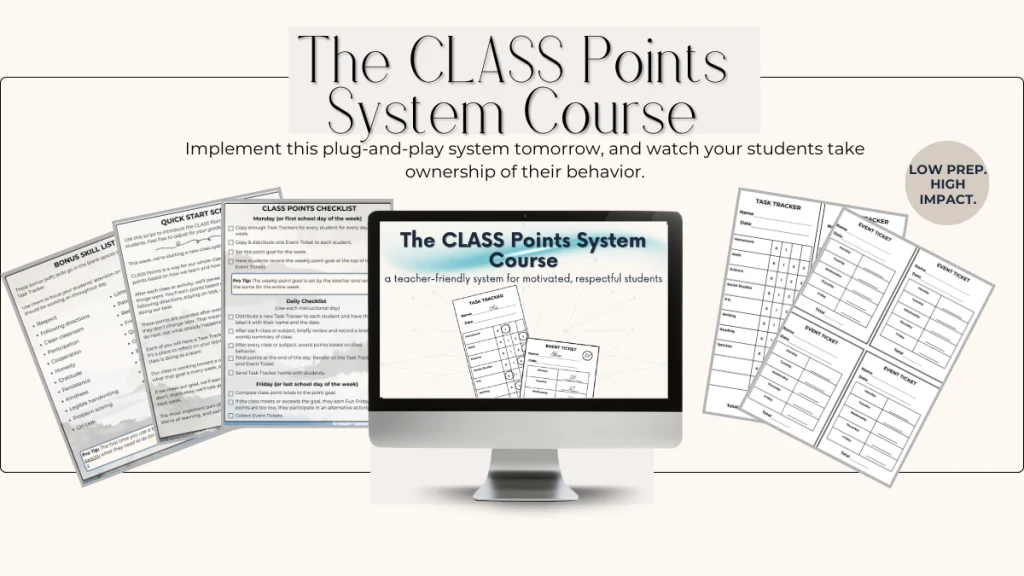
The CLASS Points System is different.
It meets students where they are, and with a universal goal and a universally adaptable behavior tracker guides students to meet those high expectations you set for them.
You can teach responsibility in the classroom – but having a system makes it easier to practice it consistently, day after day.
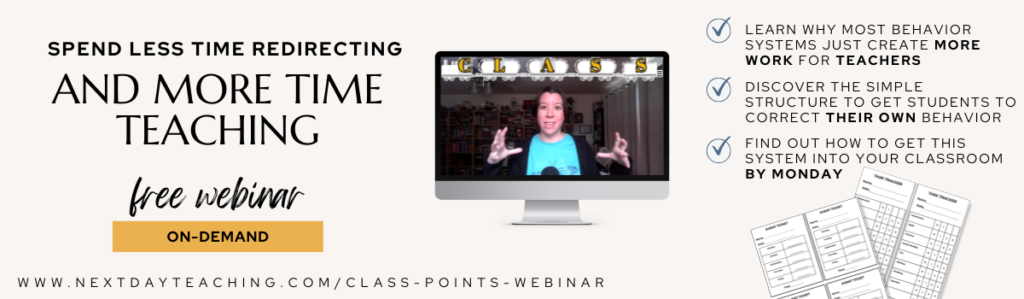
You can learn more about the CLASS Points system in this free webinar, or get the whole system for your classroom here.
F.A.Q.
Teaching responsibility in the upper elementary classroom means helping students build specific behaviors — like following directions, completing work on time, and managing their own tasks — through daily expectations and consistent practice rather than one-time lessons or reminders.
Students follow directions and act responsibly when expectations are clear, taught explicitly, and reinforced with regular check-ins throughout the day. Setting clear expectations, modeling what responsible behavior looks like, and building frequent review routines all support long-term growth rather than short-term compliance.
Behavior charts may offer momentary compliance, but they don’t build internal habits or long-term responsibility. Real responsibility develops through repeated practice, consistent expectations, and feedback over time — ideally with a system that supports these daily routines instead of a single chart or tool.
Simple classroom strategies include choosing one responsibility behavior to focus on at a time, clearly defining and teaching expectations, providing regular reminders and check-ins, anticipating pushback, and reinforcing consistency daily so students internalize the behavior over time.
Before you comment: Please take a moment to read our community guidelines. We’re building a space that’s welcoming, respectful, and helpful to all!