Being a teacher means not just teaching content. It also means figuring out how to help students work independently and take responsibility for their own learning, even when they’d much rather rely on you for every answer.
This is not just to help students grow into productive members of society; it’s also a defense mechanism for you.
You can’t be everywhere at once. You can’t help every student at once. And if your students don’t know how to work independently, that problem only gets bigger.
Why You Can’t Help Every Student at Once (and Why Students Struggle to Work Independently)
Think about what it would take to truly answer every student question, or to reteach a concept every time a student said, “I don’t get it.” You wouldn’t have time to do anything else!
But here’s the truth: If you keep giving in and giving answers, students will never learn to solve their own problems.
Now, that sounds great in theory, but it’s a whole different kettle of onions when you’re in your classroom staring at seventeen hands in the air while three students throw pencils across the room and two students refuse to do their work.
You have to do something. But what?
Because here’s the reality: when students won’t work independently, it’s usually not because they can’t; it’s because they don’t yet have a system that shows them what to do instead of asking you.
The Goal: Helping Students Work Independently
When I was first teaching, I had a class of combined third and fourth graders. Most of the students spoke a language other than English at home, and every student was performing below grade level in reading and math.
I didn’t just need a way to manage my classroom. I needed a system that would actually teach students how to work independently.
And the solution turned out to be surprisingly simple.
If you’ve ever looked into peer tutoring in the classroom or ways to get students to help each other, this idea fits right in, but with a structure that actually works during real lessons.
I called it “Resident Experts.”
Once I introduced the system, I made a list on the board of students who were performing particularly well with certain skills. Categories like “topic sentences” or “double-digit multiplication” went on the board, and below them I wrote the students’ names.
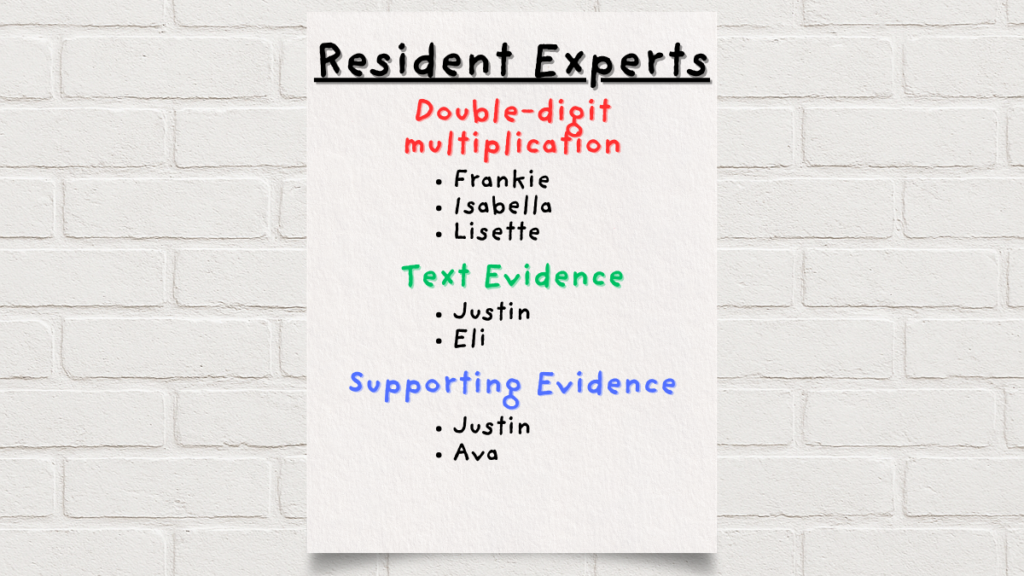
Then during math class, when the fourth graders were working on a multiplication practice page as I taught the third graders, fourth-grade students who had a question could see a Resident Expert.
They got their question answered; I kept teaching.
When we worked on expository essays later in the year, I could conference with a student while the rest of the class visited the “topic sentences” Resident Experts to get the help they needed.
(And if the student I was conferencing with needed help with, for example, in-text citations? I’d just send them to that Resident Expert when our conference was done! I didn’t have to reteach, and the conferences moved much faster.)
One surprise I didn’t anticipate? Sometimes the Resident Experts were able to explain things to their peers in a way that made the concept finally click! Everyone made progress!
How to Set Up a Student Helper System That Builds Independence

Setting up a system for Resident Experts starts with identifying skills students should be able to do independently…but don’t feel confident doing yet.
This step is key when you’re figuring out how to build independence in students, because it shows you exactly where they’re still relying on you.
As your students work on the skills, make notes (on sticky notes, scratch paper, or a spreadsheet) on which students have already mastered the skills.
Note the student name along with the skill they have mastered somewhere the rest of the class can see.
Explain to the class that some students have been doing a particularly good job with [insert your skill of choice here]. Those students are now Resident Experts (or Class Experts or Skill Leaders or whatever you want to call them) for that skill.
If students have a question about that skill, they should see a Resident Expert before asking you.
This keeps student independent work moving instead of stopping every time someone gets stuck.
A few tips:
- If you have shy students, ask them if they would be comfortable being a Resident Expert before labeling them as such in front of their classmates. Most will agree once you reassure them that they don’t actually have to teach anything in front of the class, but it’s still nice to check first.
- Try to arrange it so that every student is a Resident Expert in something before the end of the year. This won’t always be possible, but try.
- Those 5-minute check-in assignments that you don’t know what to do with (besides slapping a star on them and handing them back for students to recycle)? Those are prime candidates for Resident Expert checks.
- Sometimes a Resident Expert isn’t the one who does the skill the best but someone who thinks in a unique way or who goes above and beyond with their analysis. I had many students who wrote technically correct concluding sentences, but the students who were Resident Experts wrote conclusions that were at a higher level.
- Being a Resident Expert means not just knowing the skill but also knowing how to teach the skill. (I’m sure you know all about that difference!) If your Resident Experts start doing things for their classmates instead of helping them with the skill, have a quick Resident Expert Meeting to remind them that their job is to teach, not “do for.”
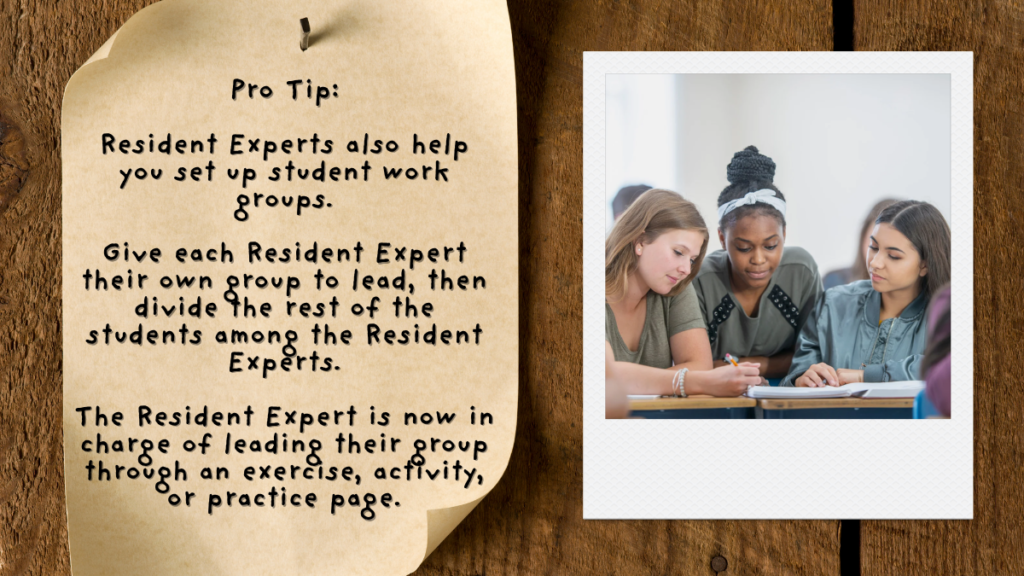
How This System Helps Students Work Independently (and Solves Classroom Problems)
When you put a Resident Experts system in place, you’ll find that your students are able to get help more quickly.
Sometimes Resident Experts are able to explain things in a way that makes sense to their peers, even though you said the same thing fifteen times and it never clicked.
Managing frequent student questions becomes easier because now you have help.
And ultimately, students become more independent. They learn how to work independently, how to take responsibility for their learning, and how to get help without relying on the teacher for every step.
If you’re trying to figure out how to help students work independently without feeling like you’re constantly being pulled in 20 directions, this is a simple place to start.
They might not know the answer to their question, but they know who to ask for help. And that’s the true measure of a successful member of society.
If you want help identifying your Resident Experts or putting this system in place, check out the Classroom Management Coaching options. There are daytime sessions, evening sessions, or asynchronous sessions conducted via secure messaging. Let’s get your students learning and working together…independently!
Frequently Asked Questions About Student Independence
To help students work independently, you need to give them a clear system for what to do when they get stuck. One effective strategy is to use peer support, such as assigning “student experts” for specific skills. Instead of immediately asking the teacher, students first check with a classmate who has already mastered the concept. This keeps learning moving and builds independence over time.
When students won’t work independently, it’s usually because they don’t feel confident or don’t know what to do when they get stuck. Many students rely on the teacher because that’s the fastest way to get help. Teaching independence means showing them alternative ways to solve problems—like asking a peer, using classroom resources, or trying a strategy before asking for help.
Managing student questions starts with setting clear expectations. Instead of answering every question yourself, create a system where students seek help from peers first. For example, a “student helper” or “Resident Expert” system allows students to get quick support without interrupting instruction, making independent work time more productive.
Peer teaching is a strategy where students help each other learn by explaining concepts, answering questions, or modeling skills. In the classroom, this can look like assigning specific students as helpers or experts in certain areas. Peer teaching not only supports struggling students but also deepens understanding for the student doing the teaching.
Building independence in students requires consistent routines and clear expectations. Start by teaching students what to do when they don’t understand something. Then, gradually shift responsibility to them by encouraging problem-solving, peer support, and persistence. Over time, students learn to rely less on the teacher and more on their own strategies and resources.
Before you comment: Please take a moment to read our community guidelines. We’re building a space that’s welcoming, respectful, and helpful to all!