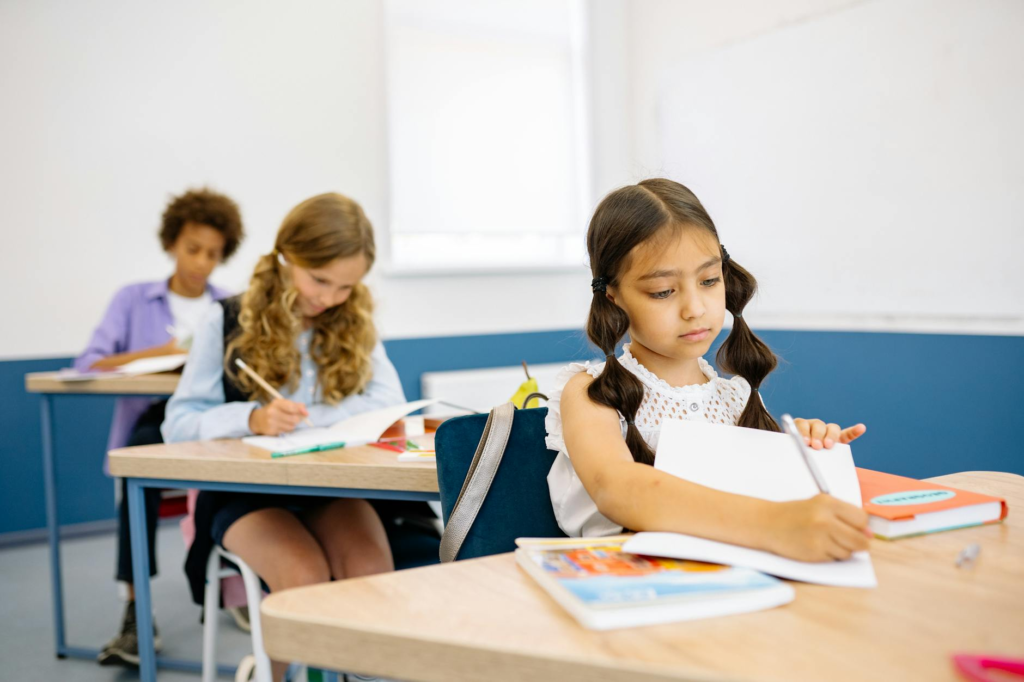
Having student helpers in the classroom can save you time, energy, and effort. But setting up a system like this takes some preparation and planning.
This type of peer tutoring classroom structure is a simple but powerful peer teaching strategy that builds independence while reducing constant teacher interruptions.
Use the steps in this guide to set up your own peer tutoring system, then step back and watch as your students help each other – without you constantly stepping in to assist.

Step 1: Pick a Skill to Start With
Just like you wouldn’t teach multiplication and fractions at the same time, you shouldn’t expect your students to start helping each other with long division…and writing topic sentences…and citing strong evidence…and identifying primary sources all at once.
Think about a skill you’re working on right now.
It should be something that you’ve already introduced and taught, and ideally something that students have had some time to practice.
The best skills are ones that require lots of repetitive practice, where some students master the skill and others still struggle.
Step 2: Identify Students Who Have Already Mastered the Skill
You know those exit tickets you promise yourself you’ll do something with…but then you just end up sticking a star on them and moving on with life?
Or those 10-point practice pages that you grade (because you feel guilty not looking at them after you assigned them as homework or independent class work)?
Those are ideal assignments to use to find your student experts.
As you flip through student work, as you conduct class discussions, and as you observe your students, make note of who is consistently scoring well for the skill.
(Bonus points if they are taking their thinking to the next level without you telling them to do so. For example, if a student is citing strong evidence instead of just citing any old piece of evidence, that is a student to add to your list.)
Record their names somewhere. You’ll need this list later.
Step 3: Talk to Your Future Student Helpers
Especially if you teach middle school students, or if you have a shy student on your list, it’s important to ask students if they’re comfortable being named Student Helpers (or Peer Tutors, or Resident Experts, or whatever you decide to call them) before you announce their names to the class.
Sample Script:
“Students, I’ve noticed that you’re doing really well with [the skill we’ve been working on]. You’re finishing early, but more than that, you’re getting good grades on all the assignments.
“I’d like to start a [Student Helper / Peer Tutor / Resident Expert] process in our classroom. If you agree, I’ll tell your classmates about this.
“Whenever we do independent work, if one of your classmates has a question, I might send them to you for help. You get to act like the teacher – not giving them the answer, but helping them it out.”
Only rarely have I had students turn down the honor – and it is an honor – and usually it was because they thought they had to give a presentation in front of the class. Once they understood that they were only going to be helping a few classmates one-on-one, they usually agreed.
Step 4: Share Student Helper Names with the Class
Tell the rest of the class who the Student Helpers are for this skill. This is a great time to encourage everyone to keep working hard…because next unit they might be a Student Helper!
Sample Script:
“Class, lately we’ve been working on [the skill you’re working on], and I know that some of you are struggling. Honestly, this is a really hard skill, and I’m so proud of you for not giving up.
“I’m sure you’ve noticed that some of your classmates have picked up on this skill quicker than others. Fortunately, they’ve agreed to be part of our Student Helper System.
“This means that if we’re working on [the skill] and you have a question, you can ask me…or you can see one of our Student Helpers.”
At this time, either name the student helpers, write the names on chart paper, or both.
Pro Tip: Writing Student Helper names on chart paper or on the board will encourage even more student independence. Struggling students can see at a glance who can help them with each skill, then take their questions to their classmates without ever involving you!
Step 5: Step Back and Let Your Student Helpers Work
One of the hardest parts of this system is stepping back and letting the Student Helpers…help. As a teacher, you’re used to always stepping in, always helping out, always answering the question.
But that leads to overwhelm and burnout, especially when you have 19 students with individual questions and no other adult in the room to help.
The next time a student (not a Student Helper) asks a question about the skill, don’t answer it right away. Instead, direct the student to one of the Student Helpers.
This is where your peer teaching strategy really starts to work.
Pro Tip: Make sure you circulate and listen in on your Student Helpers occasionally so you can catch any misconceptions early.


What Next?
As your class gets more comfortable with the Student Helper system, you can start to expand to include more skills.
This is a great way to recognize that students who struggle in one area may excel in another.
Eventually, your Student Helper List will expand to include many skills, each with numerous students attached as Student Helpers.
Pro Tip: If you teach multiple classes (switching classes in elementary grades or multiple periods in middle school), assign each class a color. Then record Student Helper names for each skill in the color that corresponds to their class. For example, double-digit multiplication experts for period 1 might be in red, while period 4 might be in green, and period 8 is in blue.
Benefits of Student Helpers in the Classroom (A Simple Peer Teaching Strategy)
There are so many benefits to using a Student Helper system:
- You are free to help students with more significant needs, or get absent students caught up, or any of the million other tasks you need to do during the day.
- You can control which students are asked in your “ask three before me” policy – so students aren’t always running for their friends.
- Student Helpers get practice explaining skills instead of just rushing through them. They have to think at a higher level, which slows them down so they don’t finish quite so fast.
- Students start to take control of their own learning by independently seeking out Student Helpers so they can continue working even if you’re busy.
- You can make groups by splitting up your Student Helpers, then dividing the rest of the class among them. Each group now has a clear leader.
- Students who aren’t immediately chosen as Student Helpers are motivated to work harder to be named Student Helpers with later skills.
If you’ve heard me call these students “Resident Experts” before, you’re not wrong! It’s the same system, just by a different name.
You can see how to set it up here.
F.A.Q.
Student helpers in the classroom are students who have mastered a specific skill and help their classmates during independent work. Instead of giving answers, they guide peers through the thinking process, making this a simple and effective peer teaching strategy.
Choose student helpers based on demonstrated mastery of a specific skill. Use exit tickets, classwork, and observations to identify students who consistently perform well and show strong understanding.
A peer tutoring classroom is a learning environment where students support each other by explaining concepts and practicing skills together. This structure builds independence and reduces the need for constant teacher intervention.
Start by selecting a single skill, identify students who have mastered it, and clearly explain their role. Teach them to guide classmates without giving answers, then gradually expand the system to include more skills over time.
Peer teaching strategies increase student independence, deepen understanding for both helpers and learners, reduce teacher workload, and create a more collaborative classroom environment.
Before you comment: Please take a moment to read our community guidelines. We’re building a space that’s welcoming, respectful, and helpful to all!