

Mornings that start with shouting over chaos, repeated directions, and a class that just won’t settle down. Sound familiar? Even if you’ve seen classroom management plans before, you might still be wondering, “How do I actually make one that works?” And more importantly… “Where do I find the time?”
I get it. Between lesson plans, grading, and that stack of permission slips, it’s easy to push “Learn How Make a Classroom Management Plan” to the bottom of the to-do list.
But here’s the truth: your classroom management plan doesn’t have to be long or complicated.
With just a few focused steps, you can create a plan that not only saves you time but also keeps your routines, rules, and systems running smoothly – a sneak peek at the kind of framework that reduces behavior headaches before they even start.
By the end of this post, you’ll have a simple, clear plan you can put together before your plan period ends.
- Step 0: Consider the Four Pillars
- Step 1: Gather What You Already Know (2 mins)
- Step 2: Eliminate duplicates (3 mins)
- Step 3: Look for Elements to Combine (3 mins)
- Step 4: Eliminate and Document (1 min)
- Example Classroom Management Plan (5th grade)
- Make a Classroom Management Plan – with time left over
- F.A.Q.
Step 0: Consider the Four Pillars
If you’ve ever searched “classroom management plan examples,” you know that there are many, many, MANY ways to make one.
Some are long and color-coded, others look like they were whipped up the night before on zero hours of sleep and a pot of coffee. (It’s not just students who procrastinate!)
I believe that simpler is better…but not if it skips the important stuff.
After 16 years in the classroom, I’ve found that every strong plan stands on four key pillars:
- Rules and expectations
- Routines and procedures
- Rewards and consequences
- Communication strategies
Keep these four pillars in mind as we go through the next steps.

Step 1: Gather What You Already Know (2 mins)
Chances are, you already have rules and routines in place. These are the behaviors your students know to do daily.
But consider:
- If you’re absent, does the sub know what the routines are?
- If you teach with another adult (co-teacher, para), are you both holding the students to the same standards?
- Do you ever reward behavior differently from one student to another…or change systems midyear?
Even the most organized teachers find it hard to stay consistent when the “system” exists only in their head.
Putting things in writing helps you stay consistent and gives other adults (and admin!) a handy reference page.
Quick exercise
Grab a piece of paper (the back of a lesson plan works fine) and divide it into 4 quadrants. Label each with one of the 4 pillars (rules, routines, consequences, communication). Now set a timer for 2 minutes and list what you already do.
Your list might include things like:
- Respect your classmates
- Homework turn-in procedure
- Assignment notebook check
- End-of-class line-up
- Quiet signal
- Detention
- Missed recess
- Positive / negative parent contact
- Monthly whole-class newsletter
Pro tip: Let the timer run out. Don’t rush this! Often you’ll have a few more thoughts to add just before time is up.
Step 2: Eliminate duplicates (3 mins)
Once you’ve got your list, tidy it up.
Did you list “assignment notebook check” twice?
Did you record “call home” in both “consequences” and “communication”?
Keep things as simple and streamlined as possible.
Step 3: Look for Elements to Combine (3 mins)
Now it’s time to combine similar items.
Remember, the goal is to keep this classroom management plan focused and functional.
For example, if you listed two routines as “homework turn-in” and “get day’s supplies,” you could combine them into “start-of-class routine.”
You don’t need to spell out every step of the routine; just note that you have one, and the students know it.
Pro tip: If students don’t know the routine, consider taking a day to review your expectations. Even if it’s the middle of winter, a refresher will save you from repeating the same direction 25 times every day.
Step 4: Eliminate and Document (1 min)
Now that your rough draft is done (and probably full of scribbles), transfer your final rules, routines, consequences/rewards, and communication strategies on a classroom management plan (like this one).
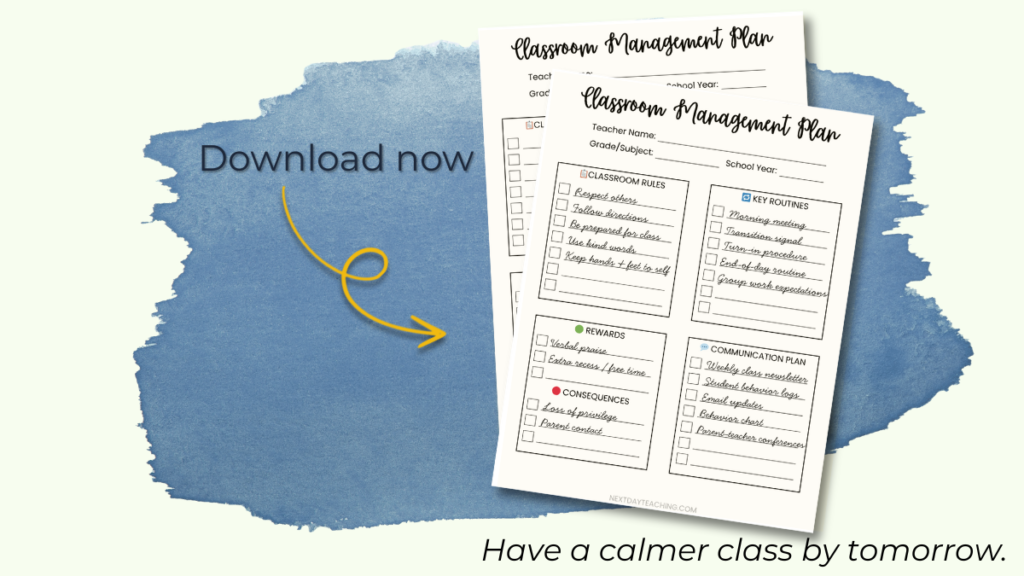
You’ll notice that the categories only have a few lines each. That’s intentional.
Ideally, you should have no more than 4 elements for each category. This means some things won’t make it to the final plan.
Before you start docking my participation points, let me explain. You might be able to remember all 10 of your (very cute, color-coded) classroom rules, but then add in your 15 procedures, 5 consequences, 6 rewards, and 2 communication strategies…and suddenly you’ve got 38 things to track.
Do you see how the numbers add up?
This way, you have at most 16 policies to remember. (And hopefully you were able to get it down to fewer than 16. For example, my “rules” category only has 1.)
It’s better to have two strong, consistent routines that you and your students know very well than 12 haphazard routines that are only sometimes enforced.
(Plus, some routines, like “hang up backpacks” probably don’t need to be formally documented.)
And don’t worry – you can always revisit and adjust midyear as needed.
Example Classroom Management Plan (5th grade)
(Adapt this sample classroom management plan to your own grade level or style)
Rules
- Respect all people and things.
- Be prepared for class.
- Follow directions the first time they’re given.
- Use kind words
- Always do your best.
Routines & Procedures
- Morning arrival: walk in, unpack backpack, turn in homework, begin morning work
- Hallway transitions: walking feet, voices no louder than a whisper, stay to the right side of the hallway
- Classroom transitions: quickly take out necessary supplies, keep desks and floor clear of clutter
- Bathroom: sign out on the clipboard, take the pass, return promptly
- Group work: voice level 1-2, everyone participates
Rewards/Positive Reinforcement
- Extra recess
- Whole class points
- Individual praise
- Fun Friday
Consequences
- Loss of points
- Phone call home
- Written or verbal apology
- Processing page
Communication with Families
- Weekly newsletter
- Parent contact for repeated minor misbehavior
- Conference request for major misbehavior
Make a Classroom Management Plan – with time left over
There you have it – less than 10 minutes to make a functional (and genuinely useful) classroom management plan.
The magic isn’t necessarily in the paper itself. (Though I think this one is pretty great.)
The magic is in the process, in thinking through what you expect and why.
- Rules and expectations – clearly stated. The fewer the better.
- Routines and procedures – practiced until automatic.
- Rewards and consequences – consistent and fair.
- Communication strategies – open and proactive.
Now quick – go make your classroom management plan while there’s still time left in your plan period!
Before you comment: Please take a moment to read our community guidelines. We’re building a space that’s welcoming, respectful, and helpful to all!
F.A.Q.
A good classroom management plan includes four main parts: rules and expectations, routines and procedures, rewards and consequences, and communication strategies. These pillars help you create a calm, predictable classroom where students know exactly what’s expected of them.
You can make a classroom management plan in 10 minutes or less by writing down what you already do, removing duplicates, combining similar items, and listing no more than four elements per category. The goal is to keep your plan short, simple, and easy to use every day.
A classroom management plan helps teachers stay consistent, save time, and reduce behavior problems. It puts routines, expectations, and consequences in writing so both students and substitutes know what to do—without needing constant reminders or last-minute decisions.
It’s best to review your classroom management plan at least once each semester. You can adjust it anytime something isn’t working smoothly, or when your students’ needs change. Small midyear updates often make a big difference in classroom consistency.
An example of a classroom management plan includes short lists for rules, routines, rewards, and communication strategies. For instance, your rules might focus on respect, your routines might cover how to start class, and your communication plan could include parent updates. You can download a free classroom management plan template with examples here.