

One of the biggest struggles new teachers face is learning how to quiet a noisy class. This challenge affects classrooms of all ages, from kindergarten through 8th, and every grade in between.
If you’ve ever gotten a class quiet once only to have the noise creep right back minutes later…this isn’t a willpower problem or a “tough kids” problem. It’s about how the routine is taught and practiced.
I like to call the method below “no-fail,” but here’s the truth: It only works if the routine is taught all the way through. Rush or skip steps, and you’ll be right back where you started: shouting over chaos.
So promise me you’ll stick to the steps? (And if you want extra support, I offer FREE 15-minute Classroom Chats to walk you through the process.)
Step 1: Figure out your quiet signal

Before introducing new quiet class expectations, get crystal clear on what you want. This step is crucial if you want to quiet a noisy class consistently.
Think through the entire process from start to finish:
- What signal will you use to get their attention? (Here are some examples you can use.)
- What will students do when they see or hear your signal?
- What could go wrong? (Some common mistakes include ignoring the signal or responding with a loud “shh!”…which only adds to the noise.)
Step 2: Explain the Expectation
Don’t assume kids just know what you want; spell it out. Tell them exactly what your quiet signal looks like and what you expect them to do in return.
Be very specific:
- “When I raise my hand, I expect everyone to stop talking and raise their hand too.”
- “You’ll hear me give quiet directions like ‘clap twice’ or ‘put your hands on your shoulders.’ Follow the directions silently”
Pro Tip: The more specific you are about your actions and student responses, the faster students will follow.

Step 3: Model the Expectation
Now show them. Literally. Stand where you’d stand, raise your hand, and wait. Let them see what it looks like in real time.
- “Sometimes I’ll be at the front, sometimes across the room. Your job is to track me with your eyes and notice when I’m asking for quiet.”
- Sit at a student desk and act out what you expect the students to do. Don’t go overboard, but do make your actions clear.
Pro Tip: Don’t drag it out. Students do need to see it clearly, but keep this part short; long demonstrations make them lose focus.
Step 4: Show Nonexamples
Nonexamples are what not to do. Act out the mistakes they’re likely to make:
- Still talking with their hand in the air
- Looking at you, then ignoring the signal
- Pretending not to notice.
You might say, “When I raise my hand, I don’t want this…” (raise your hand but keep chatting) “…or this…” (look at me, then turn back to your friend).
You might get a few giggles, but it drives the point home.
Step 5: Practice with Students

This is the step most advice skips, and the reason many strategies to quiet a noisy class work for a day…and then fall apart.
Students must experience the quiet signal in action. Repeated, low-stakes practice is the fast way to quiet a noisy class, so make it part of your daily routine.
- Give students a fun, low-stakes topic to chatter about (like weekend activities, holiday plans, what’s for lunch).
- Let them talk for 30-60 seconds, then give the quiet signal.
- Debrief: Talk about what they did well and what they need to work on. Be clear and honest.
Pro Tip: Practice multiple times throughout the day. The more authentic repetitions students participate in, the faster their behavior becomes a habit.
Other Tips
- Be patient and consistent. Remember, the goal is to quiet a noisy class without raising your voice.
- Don’t rush it. Treat it like a mini-lesson and plan for 5–10 minutes when you first introduce your quiet signal. Take your time. You’re building a routine that will save you hours of headaches later.
- Redo if needed. If practice falls apart, do it again. And again. And again. Never end on a messy attempt; students remember the last thing they did.
- Overuse it (at first). Especially on day one, use your quiet signal as often as you can. Even make up reasons. The more authentic practice they get, the faster it becomes routine.
- Don’t compromise. If your expectation is silence, don’t move on until you have silence. Wait them out. Yes, it’s awkward. Yes, it works.
- Coach them on helping. Kids love to “help,” but if you don’t guide them, they’ll just SHHH at each other (ironically, the loudest noise in the room). Give them silent tasks instead: pointing to you, gently tapping a talkative friend on the shoulder, or silently raising a finger to their lips.
- Have a class reset. If you’re consistently struggling to be heard over your class, calling a focused and intentional class meeting can quickly remind students of good behavior.
- Offer rewards or motivation. These free, low-prep Fun Friday activities are a good place to start.
Quieting a noisy class can be a struggle, especially when there are more students than teachers.
But with clear expectations and consistent practice, you’ll be able to get students to quiet down…even at 2 pm on a Friday.
I believe in you!
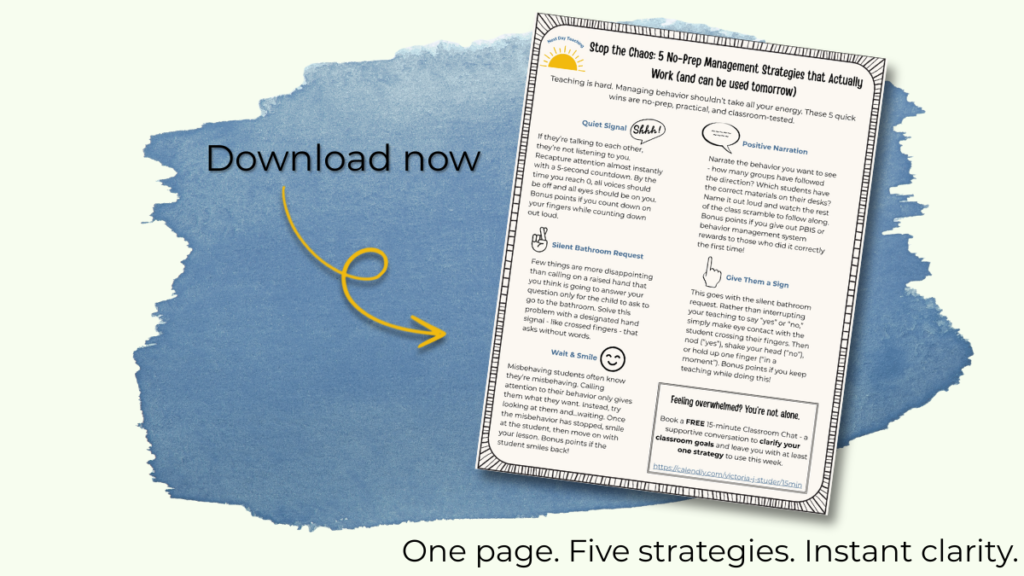
Want More Ways to Calm the Chaos?
FAQ
To quiet a noisy class, Decide your quiet signal, explain it, show it, show nonexamples, and practice it consistently. The more students experience the signal, the quicker it becomes automatic. Here are some teacher-tested quiet signals you can use.
Counting backwards from five, quiet directions, or quiet patter work well. Avoid call-and-response—it’s catchy but rarely lowers the noise level. More on why here.
One quiet signal I don’t recommend is call-and-response. Although this signal is cute and catchy, it’s not effective at lowering the noise level. You can read more here.
Contact parents if necessary. New teachers often hesitate, but students need to see consistency between home and school.
Read about how to contact parents without stress here. Parent communication templates are also available in my Etsy store.
Talk to a colleague or mentor teacher. If you don’t have one, (or if you just don’t click – no judgement!) I’d be happy to step into that role. Book a 15-minute Classroom Chat with me for guidance.
Before you comment: Please take a moment to read our community guidelines. We’re building a space that’s welcoming, respectful, and helpful to all!