
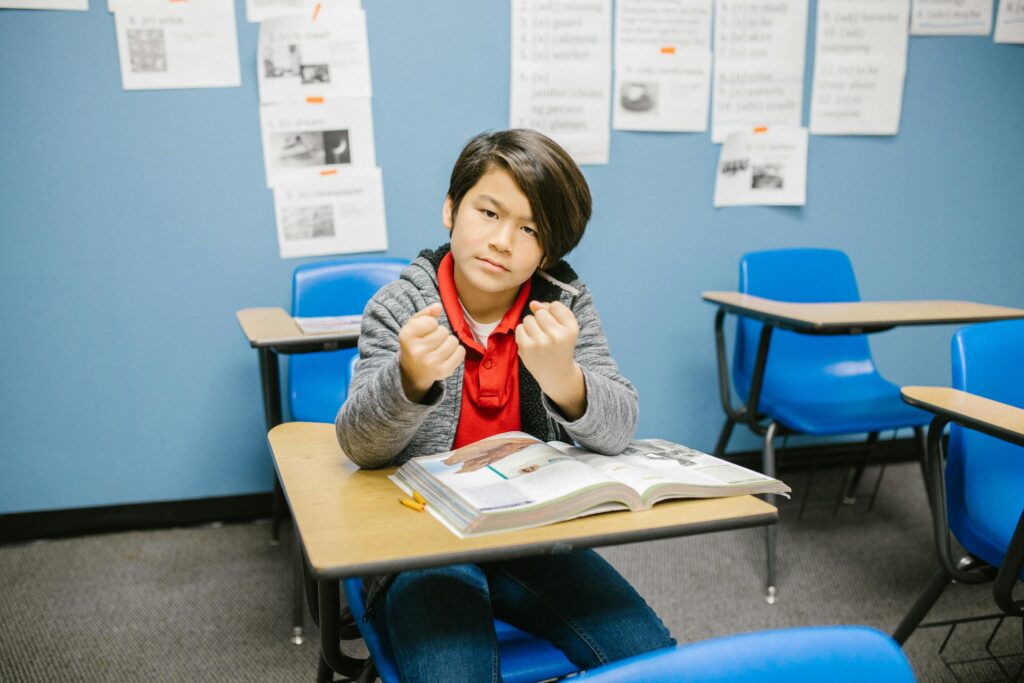
Students misbehave. It’s one of the few constants in life.
The sun rises in the east, summer break never feels long enough, and students misbehave.
The question isn’t if students will misbehave, or even when.
If we want to create calm classrooms where all students can learn and thrive, we have to ask a deeper question: Why do students misbehave?
Once you understand the why, you can address the behavior, and maybe even prevent it altogether.
Let’s look at three common reasons students misbehave. Some might surprise you!
Reason #1: Students misbehave because the work is too hard and they’re frustrated

Sometimes well-meaning teachers assign independent work (bellwork, homework, sub plans) assuming students can handle it on their own. The problem comes when the task depends on foundational skills that the students haven’t fully mastered.
I’ve been guilty of this myself.
Once, I left a worksheet for students to complete with a sub while I was in a meeting. It was early in the year, so I pulled a short story and a set of questions based on the previous grade’s standards – something I thought they’d breeze through.
Instead, I returned to chaos.
“They didn’t know how to answer the questions, and I couldn’t help them.” The poor substitute was nearly in tears.
After she left and the room settled, I asked my students what had happened.
“We didn’t know what this word meant.”
“We didn’t get what that question was asking.”
“We didn’t know how to do it.”
That’s when it hit me: It wasn’t that they didn’t want to do the work. It was that they couldn’t do the work.
My students had fallen victim to the infamous Summer Slump, and they had “forgotten” how to complete last year’s skills.
(I put “forgotten” in quotes because no skill is ever truly forgotten – it just gets buried.)
What to Do About It
If you realize (or even suspect) the work is too challenging for your students – STOP.
Seriously, stop the lesson. Nothing good comes from dragging your students through something they aren’t ready for.
(And yes, I know how many hours you put into prepping the lesson and finding the perfect materials. I’ve been there too.)
Think about it this way: In the best-case scenario, you’ll end up doing all of the thinking while your students copy the answers…and then forget it by tomorrow.
Worst case scenario? Students act out, shut down, and leave your classroom feeling frustrated.
If your whole class is struggling, stop and regroup. Try a different activity, or turn this one into a “practice” and do the “real” one tomorrow.
If just a few students are acting out because they’re overwhelmed, they may be good candidates for small group work or tier 2 intervention, depending on what your school offers.

Reason #2: Students misbehave because the work is too easy, and students are bored

I know, I know. We just talked about students misbehaving because the work was too hard, and now it’s too easy?
Welcome to teaching in the modern world, friend.
Just like tasks that are too difficult, activities that are too easy can also lead to misbehavior.
For all their talk about wanting “easy work,” or going back to preschool, the truth is that the brain wants to be challenged.
I once had a student who flat-out refused to do any math work. He already had a reputation for poor behavior, so I assumed he was being defiant.
It took me an embarrassingly long time to figure out that he was refusing to do the math work because it was too easy for him. He was already working a grade level ahead.
So I made him a deal: If he got the correct answer without a calculator, he didn’t have to show his work. But if he got it wrong, he had to show every step for that problem.
He rarely got a problem wrong.
What to Do About It
Start by identifying students who are working above the level of material you’ve assigned. Depending on their age and maturity, you might want to talk with them directly.
My student was in fourth grade, and he could understand the logic behind our agreement: “If you get it right, you’re good. If you don’t, show me how you tried.”
Once you’ve identified a high-performing student, try offering them deeper challenges, not just more work or work from the next grade level.
Here are some examples:
- In math, have the student explain how they arrived at their answer in writing. For more advanced thinkers, ask them to identify common errors other students might make…and what answers they would get if they made those mistakes.
- In English, instead of answering a chapter question in three sentences, ask for five sentences with text evidence. Or have them write two responses: One that supports an argument and one that refutes it.
You could try giving strong students a leadership role in the subject they excel in. Be careful, though. Sometimes this works well; other times it backfires if the student doesn’t enjoy being in the spotlight.
(I’ll talk more about Resident Experts in another post.)
Reason #3: Students misbehave because they’re dysregulated

Dysregulated is a fancy word that means a student is having trouble managing their emotions. They might react too strongly or shut down completely, even when nothing big seems to be going on.
This might look like crying for seemingly no reason, or yelling or hitting just because another student walked too close to their desk.
There are a number of reasons students might be dysregulated, and I am not qualified to diagnose any of them. (And honestly, some of them we might not ever fully know.)
But that doesn’t mean it’s not your job, as the teacher, to help that child navigate their moods and come out the other side.
I once had a sixth grader who struggled with emotional regulation. She would regularly cry in the hallway or make up excuses to go to the nurse’s office.
I tried taking data (we’re all told to “take data” at least once a week, right?), but it didn’t help. There didn’t seem to be any patterns.
She would melt down before library, after recess, during math. Sometimes other students were involved. Sometimes it was after I’d given a direction.
That’s when I realized:
She needed something more overarching.
Something more integrated with her day.
Not just one quick fix in the moment.
What to Do About It
My point is, sometimes students will need a more comprehensive adjustment from you. Sometimes you’ll need to change the way your classroom is set up, or how many times you give breaks, or when you teach math (if you can control your schedule).
For my student, I brought in a lawn chair and a lawn bench, some low tables, and a real live palm tree. (The live palm was the worst idea ever. But that’s another story.)
I set everything up in a corner of the classroom and named the space The Cabana.
I introduced the space to students by saying that sometimes people have rough days. Sometimes something happens, and sometimes it’s just part of sixth-grade life. If anyone was having a rough time, at any point during my class, they could go sit in The Cabana.
They still had to complete the work, but no one would bother them.
Students or I might walk past and say hi, or wish them well, but there was never any expectation on their part to respond. And when they felt better, they were welcome to rejoin us.
That student used The Cabana nearly every day, but to my surprise, nearly every other student did as well.
Some of them even came back as seventh graders just to sit in The Cabana.
Later, they told me that it really made a difference in their days, and it let them know that I cared. They felt safe.
You may be thinking of a student right now who needs something like The Cabana.
Or maybe you’re realizing that your current approach isn’t working…and you’re not sure why.
What if you don’t know the “why”?

I recognize that all of these solutions are easy for me to suggest, sitting here safely behind my computer, far away from the day-to-day chaos that is your classroom.
The truth is, it took more than 10 years in the classroom for me to get this confident with identifying and addressing why my students were misbehaving.
One tool that really helped me in my early years was an ABC tracker. (We teachers love our acronyms, don’t we?)
In this case, ABC stands for Antecedent-Behavior-Consequence. The antecedent is what happened right before the behavior. The behavior is what the student actually did – the good, the bad, and the ugly. And the consequence is what you (or another adult in the room) did about it.
ABC tracker work best when they’re used in the moment. I used to walk around the classroom with a clipboard, recording student behaviors and antecedents in real time.
A tool like this one really helped me keep organized from day to day.
Not only that, but once the tracker was filled out, or when the student came up during team meetings, other teachers and I would be able to go through the records and look for patterns.
That’s how I found out that my fourth grader was too advanced for the math work I was giving him, and how I learned that my sixth grade student would benefit from a classroom calm corner.

While you could certainly make an ABC tracker with three lines on notebook paper, this one comes with all the columns already made and labeled. There are even step-by-step directions on how to fill it out (with examples!). All you have to do is print it out.
Click here to download the ABC tracker and start looking at why your students are misbehaving.
You might be surprised by what you find, and by how much easier it is to meet their needs.
Before you comment: Please take a moment to read our community guidelines. We’re building a space that’s welcoming, respectful, and helpful to all!