

Looking for some easy, no-prep classroom management strategies?
Whether you’re a new teacher or a seasoned veteran, sometimes classroom behavior feels totally out of control.
These classroom-tested strategies will help you quiet a noisy class, reduce disruptions, and take back your teaching time – starting tomorrow.
You’ll learn:
- The #1 way to quiet a noisy class without yelling
- How to use positive peer pressure to encourage good behavior
- A silent bathroom signal (so you know what that raised hand really means)
- A silent bathroom signal response (so you don’t have to stop teaching)
- The “Wait & Smile” – a teaching trick that stops misbehaviors cold
These classroom management strategies are student-tested, teacher-approved, and ready to use right away.
Your time is precious, so let’s get right to it.
Use a Quiet Signal to Calm a Noisy Class Without Yelling

I was talking to a first-year teacher the other day. She was feeling so overwhelmed.
“I can’t even get a word in,” she said. “They just won’t stop talking.”
I asked, “What’s your quiet signal?”
She paused. “Huh. I guess I should have one of those, shouldn’t I?”
Yes, dear first-year teacher, yes you should.
Here’s the thing. If kids are talking to each other, they’re not listening to you. They’re either focused on what they’re saying or what their friend is saying. Either way, their attention isn’t on you – or your amazing lesson.
A quiet class is a listening class.
You need to get their attention before you can teach them.
There are lots of ways to do this, but I prefer the ones that make the least amount of noise.
My favorite? Counting backwards from 5. I also hold up my hand and put one finger down with each number. As I count down, I also get quieter. And students tend to match my volume automatically.
(If you want to see this in action, try teaching when you’ve lost your voice. Many kids will whisper back just because you whispered first!)

Positive Narration: Classroom Management That Reinforces Good Behavior

This strategy is great to use when you have a few students who follow the rules…and then everyone else.
So often students only get called out when they make poor behavior choices. Meanwhile, the ones who always do the right thing never get noticed.
Let’s flip that script.
The next time you give a direction, like “Clear off your desk except for a pencil,” Watch closely. Who follows that direction first – and quietly?
Praise that student or that group out loud: “I love the way Juan has put away his reading book and only has a pencil on his desk. Wow, this whole group of students has followed that direction without a sound! Great job everyone!”
Watch the rest of the class scramble to catch up. They want praise too!
Catch the good behavior you want to see more of.
This strategy works especially well if your school uses Positive Behavior Intervention System (PBIS) rewards, or if you have a classroom system for individual points, tickets, or class currency.
Give a small reward to the first few students who followed your direction – maybe a PBIS ticket, a classroom point, or whatever your behavior system uses.
Now the students connect positive behavior with positive results.
(Which is the point of PBIS.)
A Silent Bathroom Signal Keeps Lessons Flowing Without Interruptions

Has this happened to you?
You’re leading a class discussion. It’s going great. The kids are building on one another’s ideas, and everyone’s engaged. Then you notice Stuart has his hand raised.
You’re excited. Stuart never volunteers during class discussions.
So you call on him.
“Can I go to the bathroom?”
Sound familiar?
Not only does that raised hand give you the wrong impression (that the child wants to contribute), it can also derail the whole flow of your lesson.
Here’s an alternative: a silent bathroom signal that lets students get their needs met… without interrupting the moment.
No words, no disruptions.
You can use any (appropriate) hand signal, but I recommend crossed fingers. It’s clear, it’s uncommon, and it happens to be the sign language letter R – for restroom.
When you teach this signal, be sure to tell them to also make eye contact with you while their crossed fingers are raised. (Why? Keep reading – I’ll explain that in the next section.)
Now, the next time Stuart raises his hand, you’ll know exactly what he needs – and it’s not to offer some insightful commentary on Hatchet.
Nonverbal Teacher Signals Minimize Disruption

Now that students have a silent bathroom signal, it’s time to reveal what your responses might be.
- A nod means: “Yes, you can go right now.”
- A head shake means: “No, not at this time.”
- And holding up one finger means: “Wait one moment, then ask again.”
This is why students need to make eye contact with you when they use the bathroom signal. The whole point is to communicate without interrupting the lesson. If you still have to say, “You have to wait,” it breaks the flow – just like if they had asked out loud.
But once students become used to this nonverbal interaction, something magical happens: You can teach an entire lesson while three kids quietly take bathroom breaks – without a single disruption.
Students get what they need without interrupting the lesson.
True story: I once had a principal observe my class during a formal observation. Later, in our post-observation meeting, she said, “I was concerned that students kept leaving the classroom without permission.”
I explained the bathroom signals I used, and she was stunned.
My cues had been so subtle, she didn’t even notice them!
Turns out, that’s the kind of classroom management that gets attention (in the best way).
Wait & Smile: A Quiet Strategy That Stops Disruptions Cold

This is possibly my favorite strategy – because it’s so unexpected.
Most of the time, students know when they’re misbehaving.
They know they’re not supposed to talk during the lesson, or draw on the desk, or type “hello” on their calculators using “0.1134.”
(Do kids still do that??)
The usual approach is to call them out in front of the class: Say their name, remind them of the rule, assign a consequence like lunch detention or missed recess.
But “Wait & Smile” flips the script.
Instead of correcting the student, you do…nothing.
Stop talking.
Stop moving.
Look directly at the student (who is probably not looking at you.)
And just…wait.
Sometimes the most powerful discipline strategy is silence.
When the student does look at you, they will probably stop the behavior as well.
Wait one more second.
Then smile.
And go right back to teaching, like nothing happened.
Why does this work? First, it interrupts the negative behavior. When you stop teaching, the students notice. Curiosity kicks in.
Second, when you smile, something powerful happens: the student’s mirror neurons activate. They’re likely to smile back, and they get a little boost of dopamine too.
Over time, they’ll start associating doing the right thing with that little dopamine hit.
Oh, and that extra second of waiting? That’s what fully breaks their train of thought and helps them reset.
Aren’t brains fun?
Wrap Up: Your One-Page Lifesaver
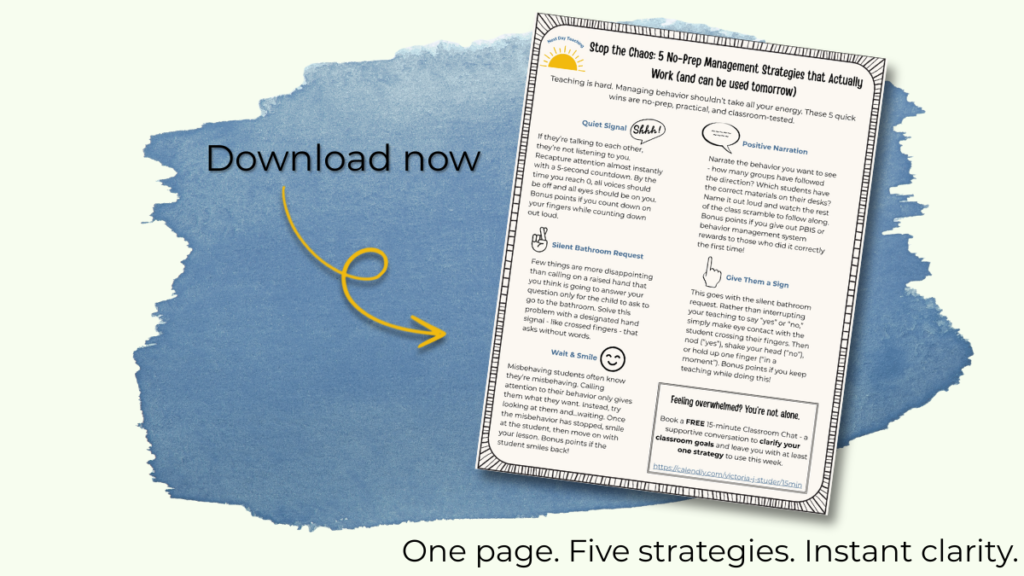
These five no-prep classroom management strategies can make a huge difference.
But let’s be real: you’re probably not going to scroll back through this post while your class is falling apart.
That’s why I created Stop the Chaos – a one-page cheat sheet with all five strategies ready to print, save, or stash in your desk drawer for when you need it most.
Download your free classroom management cheat sheet here.
Now take a deep breath.
You can do this.
Before you comment: Please take a moment to read our community guidelines. We’re building a space that’s welcoming, respectful, and helpful to all!